📋 In This Article
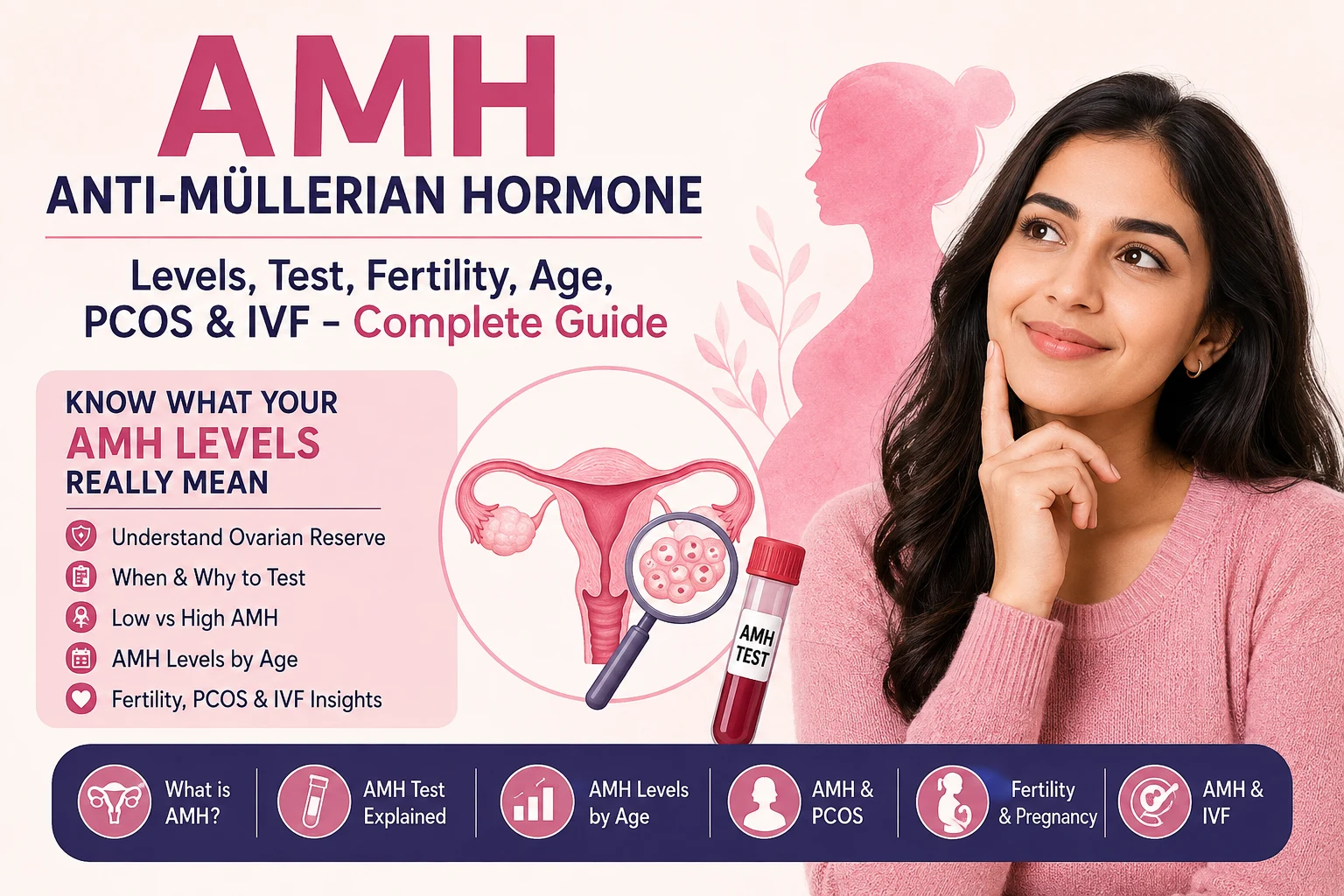
- What Is Anti-Müllerian Hormone (AMH)?
- What Does AMH Tell You About Fertility?
- What Is an AMH Test?
- AMH Normal Range
- AMH Levels by Age
- What Does Low AMH Mean?
- What Does High AMH Mean?
- AMH and PCOS
- AMH and Egg Quality
- AMH and IVF
- AMH Compared With Other Fertility Tests
- Can AMH Predict Natural Pregnancy?
- Can AMH Predict Menopause?
- Can AMH Levels Be Increased Naturally?
- AMH and Pregnancy
- Factors That Can Affect AMH Results
- How to Interpret Your AMH Result
- When Should You Consider an AMH Test?
- AMH Test Limitations
- Frequently Asked Questions
If a doctor has mentioned checking your AMH, or you've come across the term while reading about fertility, it's easy to walk away more confused than when you started. The number on the lab report looks precise, but what it actually means for your body and your plans is a lot less black-and-white than it seems.
This guide walks through what Anti-Müllerian Hormone actually is, what an AMH test can and can't tell you, how levels typically change with age, and how AMH fits into the bigger picture of PCOS, IVF, natural conception, and menopause. The goal is to leave you with a clearer sense of what your own result might mean, and what questions are worth asking your doctor next.
🔑 Quick Answer
- AMH is a hormone made by small follicles in the ovaries, and it's used as a marker of ovarian reserve — roughly, how many eggs remain.
- AMH tells you more about egg quantity than egg quality, and it does not directly measure your chance of getting pregnant.
- Low AMH does not automatically mean you cannot conceive naturally. Normal AMH doesn't guarantee pregnancy either.
- AMH is one piece of a larger picture that includes your age, cycle history, other hormone tests, and an ultrasound when needed — not a standalone verdict.
What Is Anti-Müllerian Hormone (AMH)?
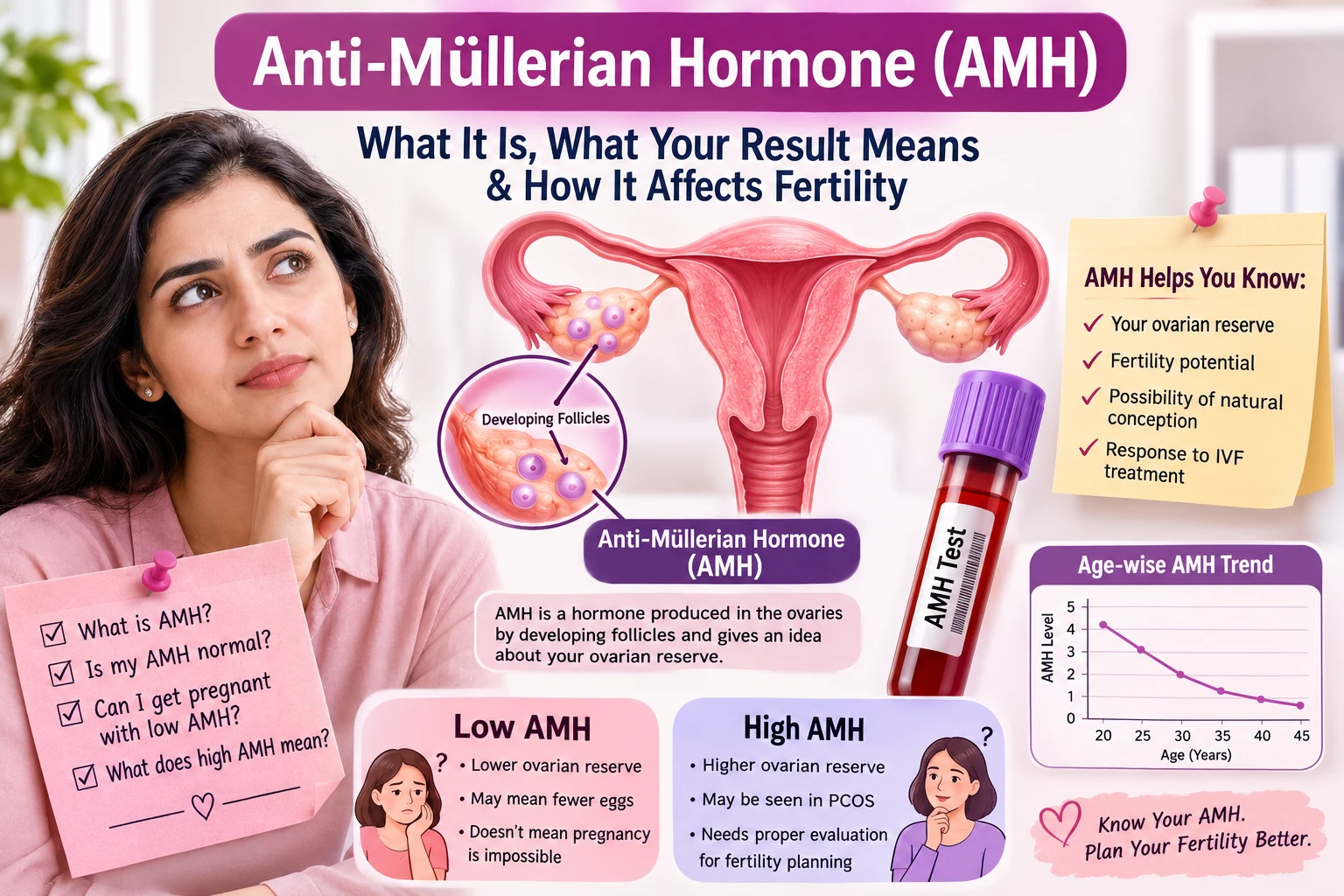
Anti-Müllerian Hormone, usually shortened to AMH, is a hormone produced by the granulosa cells that surround developing eggs inside small ovarian follicles. It isn't made in the brain or pituitary gland like many reproductive hormones — it's produced locally, inside the ovaries themselves, specifically by the follicles that are in an early, resting stage of development.
Each woman is born with a fixed number of eggs, and that number only goes down over time; it doesn't get replenished. This total is often referred to as ovarian reserve. Because AMH is released by the small follicles that make up part of this reserve, blood levels of AMH tend to correlate with how many of those follicles are present at a given point in time. That's why AMH has become one of the more commonly used blood markers for estimating ovarian reserve, alongside tools like antral follicle count on ultrasound.
It's worth noting that AMH isn't unique to fertility medicine — the hormone is also involved in early fetal development, where it plays a role in the differentiation of reproductive organs. In adult women, though, its main clinical use is as a window into the ovarian follicle pool.
What Does AMH Tell You About Fertility?
AMH gives a general sense of how many eggs are likely left in the ovaries relative to what's typical for a given age. That's genuinely useful information in certain situations — particularly when planning IVF or investigating unexplained fertility struggles. But it's easy to overstate what a single number can do.
Here's what AMH is reasonably good at reflecting:
- An estimate of ovarian reserve compared with population averages for your age
- How the ovaries are likely to respond to fertility medications during IVF stimulation
- Supporting evidence when a condition like PCOS or diminished ovarian reserve is suspected
Here's what it cannot reliably tell you:
- Whether you will get pregnant this month, this year, or ever
- The quality or genetic health of your remaining eggs
- Your exact remaining "fertile years"
Fertility depends on far more than the number of eggs sitting in reserve — it depends on regular ovulation, open fallopian tubes, a receptive uterine lining, sperm quality where relevant, and plain timing. AMH speaks to only one part of that system. Treating it as a single "fertility score" tends to cause more anxiety than clarity, and that's a framing worth resisting even when a lab report makes the number look definitive.
What Is an AMH Test?
An AMH test is a simple blood draw. A small sample is taken from a vein in your arm, sent to a lab, and measured for the concentration of Anti-Müllerian Hormone circulating in your blood.
A few practical points that come up often:
- Fasting: Not required. You can eat and drink normally beforehand.
- Cycle day: One of the genuine advantages of AMH is that, unlike hormones such as FSH or estradiol, it stays relatively stable across the menstrual cycle. Many clinics allow testing on any day, including during your period, though some still prefer a particular window for consistency — it's worth confirming with the lab or clinic you're using.
- Preparation: Generally none beyond what your clinic specifically asks for. Hormonal birth control can lower measured AMH somewhat in some women, so mention any contraception you're using when you book the test.
- Turnaround: Results typically take a few days to a week or so, though this varies by lab and clinic, and it's reasonable to ask your provider what timeline to expect.
Because it doesn't require precise cycle-day timing, AMH testing tends to be more convenient to schedule than several other fertility hormone tests, which is part of why it's become such a routinely used marker.
AMH Normal Range
There isn't one universal "normal" AMH number that applies to every woman, every lab, and every age. Reference ranges differ from laboratory to laboratory because different testing platforms and assay methods can produce slightly different results for the same blood sample. This is one of the more common sources of confusion — two women with genuinely similar ovarian reserve could get numbers that look different simply because their samples were processed by different labs.
That said, results are broadly grouped into three general categories:
- Low AMH: Suggests a smaller number of remaining follicles than is typical for your age group.
- Typical or average AMH: Falls within the range most commonly seen for your age.
- High AMH: Suggests a larger follicle pool than typical, which in some women is linked to PCOS.
Always read your result against the reference range printed on your own lab report, not a number pulled from somewhere else online, and always interpret it together with your age and the rest of your fertility picture rather than in isolation.
AMH Levels by Age
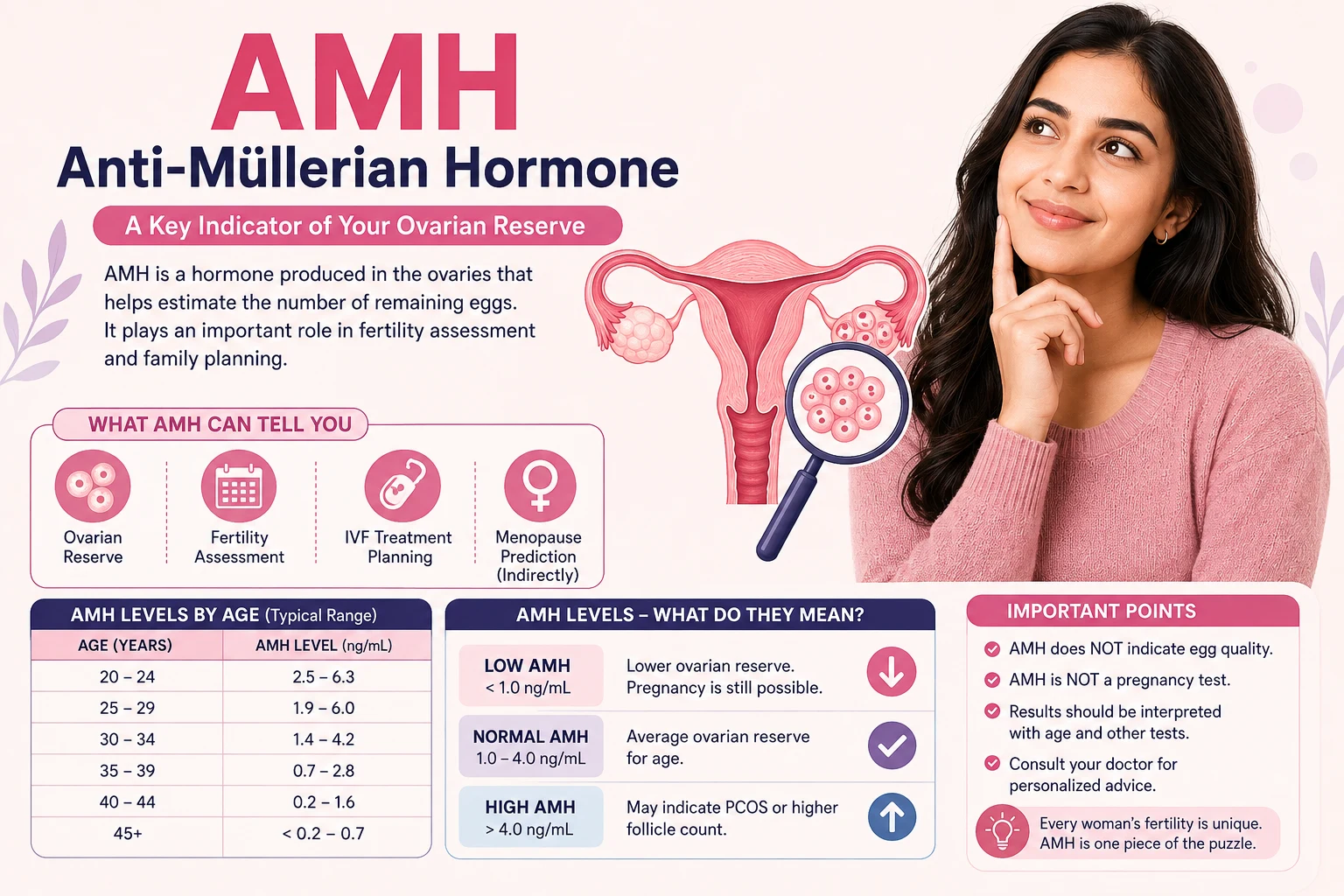
AMH generally declines as women get older, because the total pool of ovarian follicles naturally shrinks over time. This decline isn't perfectly linear, and it isn't the same for every woman — some women in their late 30s have AMH levels typical of a much younger average, and some younger women have levels on the lower end for their age. Genetics, certain medical conditions, and individual variation all play a role.
The table below shows commonly cited approximate ranges by age group, gathered from typical patterns reported across fertility clinics. Treat these as a general reference point, not a personal verdict — your own lab's reference range is what actually applies to your result.
| Age Group | Typical AMH Range (ng/mL)* | General Pattern |
|---|---|---|
| 20–24 | ~2.5 – 6.3 | Ovarian reserve is usually at its highest |
| 25–29 | ~1.9 – 6.0 | Still typically in a higher range |
| 30–34 | ~1.4 – 4.2 | Gradual decline tends to become noticeable |
| 35–39 | ~0.7 – 2.8 | Decline usually continues, more variability between individuals |
| 40–44 | ~0.2 – 1.6 | Reserve is generally lower on average |
| 45+ | ~0.2 or below | Approaching the natural transition toward menopause |
*Approximate, commonly reported ranges for general reference only. Reference ranges vary by laboratory and testing method — always compare your result with the range provided on your own lab report.
Age remains an important fertility factor even when AMH looks reassuring. Egg quality tends to decline with age in ways that AMH doesn't capture, which is why a normal AMH result in your late 30s or early 40s doesn't erase the effect of age on your overall chances of conceiving, especially without medical assistance.
🌸 Curious About Your Fertility Picture?
Our free educational Fertility Factors Estimate can help you think through general lifestyle factors alongside any lab results — it is not a fertility test, while you plan your next conversation with your doctor.
Check My Fertility Score →What Does Low AMH Mean?
A low AMH result generally points to a smaller remaining pool of ovarian follicles than is typical for your age. It's sometimes associated with what's called diminished ovarian reserve, though that's a clinical diagnosis your doctor would make by weighing AMH alongside other findings, not something a single number confirms on its own.
Possible associations with lower AMH include natural age-related decline, prior ovarian surgery, certain autoimmune conditions, past chemotherapy or radiation treatment, and in some cases, no clearly identifiable cause at all. On its own, low AMH typically doesn't cause noticeable day-to-day symptoms — it isn't something you'd feel. Some women only find out through fertility testing.
Here's the part that gets lost most often: low AMH does not automatically mean you cannot become pregnant, naturally or otherwise. Ovulation can still happen regularly even with a reduced number of remaining follicles, and plenty of women with low AMH conceive without any fertility treatment at all. What low AMH may mean, in practical terms, is a potentially shorter window of time to work with, and possibly a different expected response if IVF is ever pursued. It's a reason to have an informed conversation with a doctor sooner rather than later if you're trying to conceive, not a reason to assume the outcome is already decided.
What Does High AMH Mean?
A high AMH result generally reflects a larger-than-typical pool of small antral follicles in the ovaries. On its own, that isn't a problem — it simply indicates more follicles are present than average for your age.
High AMH is commonly associated with polycystic ovary syndrome (PCOS), since one hallmark of PCOS is a higher number of small follicles that don't consistently mature and release an egg on a regular cycle. That said, not every woman with high AMH has PCOS, and not every woman with PCOS has notably elevated AMH — the two overlap often but aren't interchangeable.
It's also worth being clear that high AMH does not automatically mean "better" fertility. Because PCOS often involves irregular or absent ovulation, a higher egg count doesn't necessarily translate into an easier time conceiving each month. And in the context of IVF, very high AMH matters for a different reason: it can signal a stronger-than-average response to stimulation medication, which raises the importance of careful monitoring to reduce the risk of ovarian hyperstimulation syndrome (OHSS), a condition fertility specialists actively watch for and manage during treatment.
AMH and PCOS
AMH tends to run higher in women with PCOS because the condition typically involves an increased number of small antral follicles compared with the general population. Since AMH is produced by exactly these follicles, more of them generally means a higher circulating AMH level — this is part of why AMH and antral follicle count on ultrasound often track together in PCOS.
Even so, AMH alone cannot diagnose PCOS. PCOS is typically diagnosed using a combination of criteria, which commonly include irregular or absent ovulation, clinical or lab signs of elevated androgens, and the appearance of the ovaries on ultrasound. AMH can support that picture — some clinicians use it as an additional data point, and research into using AMH as part of PCOS criteria continues — but it isn't a replacement for the full clinical evaluation.
Ultrasound remains the more established tool for directly visualizing follicle number and ovarian appearance, while AMH offers a convenient, cycle-independent blood test that correlates with it. If PCOS is suspected, expect your doctor to look at your full symptom history and possibly several tests together rather than relying on AMH by itself.
AMH and Egg Quality
This is one of the most important distinctions in the entire conversation around AMH, and it's worth stating plainly: AMH tells you more about ovarian reserve than egg quality.
Ovarian reserve refers to quantity — roughly how many eggs remain. Egg quality refers to something different: the chromosomal and genetic health of individual eggs, which affects whether an egg can fertilize normally and develop into a healthy pregnancy. A woman can have a strong AMH level and still have age-related changes in egg quality, and conversely, a woman with lower AMH may still have eggs of good quality.
Egg quality is much more closely tied to age than AMH is. As women get older, the proportion of eggs with chromosomal abnormalities tends to rise, which is a separate biological process from the gradual decline in follicle numbers that AMH reflects. There isn't currently a routine blood test that directly measures egg quality — it's typically assessed indirectly, for example through outcomes during IVF, rather than predicted in advance from a hormone level.
AMH and IVF
AMH is one of the standard tests fertility clinics use before starting IVF, mainly because it helps doctors estimate how the ovaries are likely to respond to stimulation medication. That's genuinely useful for planning: it helps guide medication dosing and set realistic expectations for how many eggs might be retrieved in a cycle.
In general terms:
- Low AMH and IVF: May suggest a lower expected egg yield from stimulation, which can mean adjusted medication protocols and, in some cases, a smaller number of eggs retrieved per cycle.
- High AMH and IVF: May suggest a stronger response to stimulation and potentially more eggs retrieved, but it also raises the importance of careful monitoring because of the increased risk of OHSS, particularly in women with PCOS.
What AMH cannot do is guarantee an outcome. It doesn't predict embryo quality, whether a transferred embryo will implant, or whether a pregnancy will continue successfully. IVF success depends on many additional factors — age, sperm quality, uterine receptivity, embryo development, and simple biological variability. A fertility specialist uses AMH as one input among several when designing an individualized treatment plan; it isn't used, and shouldn't be treated, as a stand-alone predictor of whether IVF will work for you.
AMH Compared With Other Fertility Tests
Doctors rarely rely on a single test when evaluating fertility. AMH is usually considered alongside other markers, each of which offers a different piece of the picture.
| Test | What It Generally Assesses | Cycle-Day Dependent? |
|---|---|---|
| AMH | Ovarian reserve, via hormone produced by small follicles | No — relatively stable across the cycle |
| FSH (Follicle-Stimulating Hormone) | Pituitary signal that rises as ovarian reserve declines | Yes — typically measured early in the cycle (around day 2–4) |
| Estradiol | Often measured alongside FSH to help interpret the result accurately | Yes — same early-cycle window as FSH |
| Antral Follicle Count (AFC) | Direct ultrasound count of small follicles visible in the ovaries | Usually early in the cycle for consistency |
| Pelvic Ultrasound | Overall ovarian appearance, follicle count, uterine structure | Depends on what's being assessed |
Doctors often use several of these together because each has different strengths. AFC and ultrasound offer a direct, real-time look at the ovaries; AMH offers a convenient, cycle-independent blood marker; and FSH with estradiol adds a hormonal signal that reflects how hard the pituitary gland is working to stimulate the ovaries. No single test tells the whole story on its own.
Can AMH Predict Natural Pregnancy?
Not reliably, and this is worth saying directly because it's one of the most searched questions about AMH. Research has generally found that AMH does not strongly predict whether a woman will conceive naturally within a given time frame, particularly among women without a known fertility diagnosis. It reflects egg quantity, not the many other variables that determine whether a pregnancy happens in a particular month or year.
Low AMH does not mean pregnancy is impossible. Many women with lower-than-average AMH conceive without medical intervention, because regular ovulation matters more for natural conception than the total number of eggs remaining in reserve. On the flip side, a normal or high AMH result doesn't guarantee pregnancy either — ovulation regularity, tubal patency, uterine factors, sperm quality, and timing all play independent roles.
If you're actively trying to conceive, understanding your cycle and fertile window tends to be more directly useful day to day than an AMH number on its own.
Can AMH Predict Menopause?
AMH declines as the ovaries age, and it typically approaches very low or undetectable levels as menopause nears, since fewer follicles remain by that stage. Because of this pattern, AMH has been studied as a possible tool for estimating how close someone might be to menopause.
The honest answer is that this prediction is still fairly imprecise at the individual level. AMH can offer a general sense of ovarian aging, but it shouldn't be presented as an exact countdown or timeline to menopause. Studies looking at AMH as a menopause predictor have found meaningful variability between individuals, and factors beyond AMH also influence the timing of menopause. If you're specifically wondering about perimenopause symptoms and timing, that conversation is often better anchored in your actual cycle changes and symptoms alongside any lab results, rather than AMH in isolation.
Can AMH Levels Be Increased Naturally?
This is a common hope, and it's worth answering carefully. Current evidence does not support the idea that any particular food, vitamin, herb, or supplement reliably increases ovarian reserve or raises AMH in a meaningful, lasting way. Ovarian reserve reflects the number of follicles you have, and that number doesn't get replenished — it's a finite pool established well before birth.
That said, there's an important distinction between increasing ovarian reserve and supporting general reproductive health, and the second one genuinely matters:
- Balanced nutrition: A varied diet supports overall hormonal and metabolic health, which can influence ovulation regularity even if it doesn't change your total egg count.
- Not smoking: Smoking is associated with faster ovarian aging in the research literature, making it one of the more clearly modifiable factors.
- Moderate alcohol intake: Heavy alcohol use has been linked to reproductive health concerns more broadly.
- Regular, moderate exercise: Supports metabolic and hormonal balance, though excessive or extreme exercise can sometimes disrupt ovulation.
- Adequate sleep: Poor sleep affects hormonal regulation throughout the body, including reproductive hormones.
- Supplements: Some are marketed specifically for "egg health" or ovarian reserve. The evidence behind most of these claims is limited or preliminary, so it's reasonable to be skeptical of strong promises and to discuss any supplement with your doctor before starting it, especially if you're also being evaluated for fertility treatment.
In short: healthy habits support your overall reproductive and general health, and that's worthwhile on its own terms — but they shouldn't be expected to meaningfully raise a low AMH result.
AMH and Pregnancy
A cluster of related questions comes up here, so it's worth addressing them directly.
Can women with low AMH become pregnant? Yes, many do, including without fertility treatment. Low AMH is a risk factor worth discussing with a doctor, not a guarantee of infertility.
Can women with high AMH become pregnant? Yes, though if high AMH is related to PCOS, irregular ovulation can make timing conception more unpredictable, which is a separate issue from the AMH number itself.
Is AMH a pregnancy test? No. AMH has nothing to do with detecting an existing pregnancy — that's the role of hCG testing, whether by blood or urine.
Does AMH confirm infertility? No. Infertility is a clinical diagnosis generally based on a longer pattern — commonly defined as not conceiving after 12 months of regular, unprotected intercourse (or 6 months for women over 35) — evaluated alongside multiple tests, not determined by AMH alone.
Does AMH predict miscarriage? There isn't strong evidence that AMH alone reliably predicts miscarriage risk. Pregnancy loss has many potential contributing factors, and assessing that risk requires a broader medical evaluation rather than a single hormone level.
Factors That Can Affect AMH Results
A number of variables can influence a measured AMH result, which is part of why interpretation should always involve a doctor rather than a number viewed in isolation:
- Age: The single most consistent factor influencing AMH over time.
- PCOS: Generally associated with higher-than-typical AMH.
- Hormonal contraception: Some research suggests combined hormonal birth control may modestly lower measured AMH while you're using it, though levels are generally understood to return toward baseline after stopping. It's worth telling your doctor about any contraception you're using when discussing results.
- Ovarian surgery or certain treatments: Procedures involving ovarian tissue, as well as treatments like chemotherapy or pelvic radiation, can reduce ovarian reserve and lower AMH.
- Laboratory differences: Different assay methods and reference ranges between labs can produce different absolute numbers even for similar underlying reserve.
- Individual biological variation: Some fluctuation between tests is normal and doesn't necessarily indicate a meaningful change.
None of these factors should be treated as decisive on their own — they're context your doctor weighs together when reading your result.
How to Interpret Your AMH Result
If you've just received an AMH result, it can help to think through it alongside these pieces rather than the number by itself:
- The AMH value itself — where it falls relative to the reference range provided.
- Your age — since typical ranges shift meaningfully across the reproductive years.
- The laboratory's specific reference range — not a number pulled from a different lab or a general online chart.
- Your menstrual and reproductive history — cycle regularity, past pregnancies, and any known reproductive conditions.
- Antral follicle count or ultrasound findings, where these have also been done.
- Other fertility test results, such as FSH, estradiol, or thyroid function if relevant.
- Your personal fertility goals and timeline — the same AMH number can mean something quite different to someone trying to conceive this year versus someone thinking about egg freezing five years from now.
An AMH result read in isolation, without this context, can easily cause more worry than it should — or, just as easily, false reassurance. A conversation with your doctor is the step that turns a number into something actually useful.
When Should You Consider an AMH Test?
AMH testing isn't something every woman needs as a matter of routine. It tends to be more useful in specific situations, including:
- As part of a broader fertility evaluation, especially if you've been trying to conceive without success
- Before starting IVF or another assisted reproductive treatment, to help guide medication planning
- If diminished ovarian reserve is suspected based on age, cycle changes, or family history
- When investigating suspected PCOS or other ovarian conditions, as supporting information
- When considering fertility preservation, such as egg freezing, to help inform planning discussions
If none of these apply to you right now, that's completely reasonable — AMH testing is a tool for specific questions, not something everyone needs to check by default.
AMH Test Limitations
This is worth stating clearly and directly, because it's easy to lose sight of amid all the numbers and tables above:
- AMH is not a complete fertility test on its own.
- AMH does not directly measure egg quality.
- AMH does not guarantee pregnancy, whether the level is low, normal, or high.
- AMH does not, by itself, diagnose infertility.
- AMH alone cannot diagnose PCOS.
- Reference ranges vary between laboratories, so results aren't directly comparable across different labs without care.
- Results always need to be interpreted within your broader clinical picture, not read as a standalone verdict.
AMH alone cannot diagnose infertility or PCOS — it's genuinely one piece of a larger puzzle, and treating it as more than that tends to create unnecessary stress.
🌸 Track Your Cycle While You Plan Next Steps
Our free Ovulation Calculator and educational Fertility Factors Estimate can help you reflect on your own patterns while you talk through any test results with your doctor.
Try the Ovulation Calculator →Final Takeaway
AMH is a genuinely useful piece of the fertility puzzle, particularly for estimating ovarian reserve and planning IVF treatment. But it was never meant to function as a standalone fertility score, and reading it that way tends to create more anxiety than clarity. Low AMH doesn't close the door on pregnancy, and high or normal AMH doesn't guarantee one either.
If you've received an AMH result that's worrying you, or you're considering testing for the first time, the most useful next step is usually a conversation with a gynecologist or fertility specialist who can put the number in context with your age, your cycle, and the rest of your health picture — rather than trying to interpret it alone.
Frequently Asked Questions
Further reading from health authorities
General topic pages from authoritative organizations for further reading. They are suggested resources and are not a line-by-line citation of the statements in this article. Always confirm personal medical decisions with a healthcare professional.