Contributor disclosure: This is a guest research article by Fliar BI, the research team at Fliar Business Intelligence Private Limited, prepared for Bloom Health Woman. The data, analysis and views are the contributor’s own and have not been independently verified by Bloom Health Woman.

Research prepared exclusively for Bloom Health Woman
Key finding: premenstrual dysphoric disorder (PMDD) takes 3.9% of search interest among nine women's-health conditions but only 0.9% of the research findings published about them in 2025, a ratio of about four to one. Menopause and PCOS show the same pattern at roughly 1.9 and 1.7 to one. For endometriosis, postpartum depression and infertility, research is ahead of searching.
This analysis measures attention, not disease burden. It does not say which condition affects more women, and it gives no medical advice. It asks a narrower question: where do public questions and published research sit out of proportion?
What was compared
We looked at nine conditions: PCOS, endometriosis, menopause, uterine fibroids, infertility, PMDD, vulvodynia, adenomyosis and postpartum depression. For each we compared three signals: worldwide search interest (52 weeks to 18 October 2026), news and blog coverage (2023 to 2025 for volume, plus a theme comparison of two 12-month windows ending 31 May 2025 and 31 May 2026), and research output, counted as claims extracted from research papers (2025 is the latest full year). All shares are shares within these nine, so a ratio of 1x means search and research are in proportion. Where a signal could not be sourced, we left it out (see the method note).
Finding 1: Questions outrun research for PMDD, menopause and PCOS
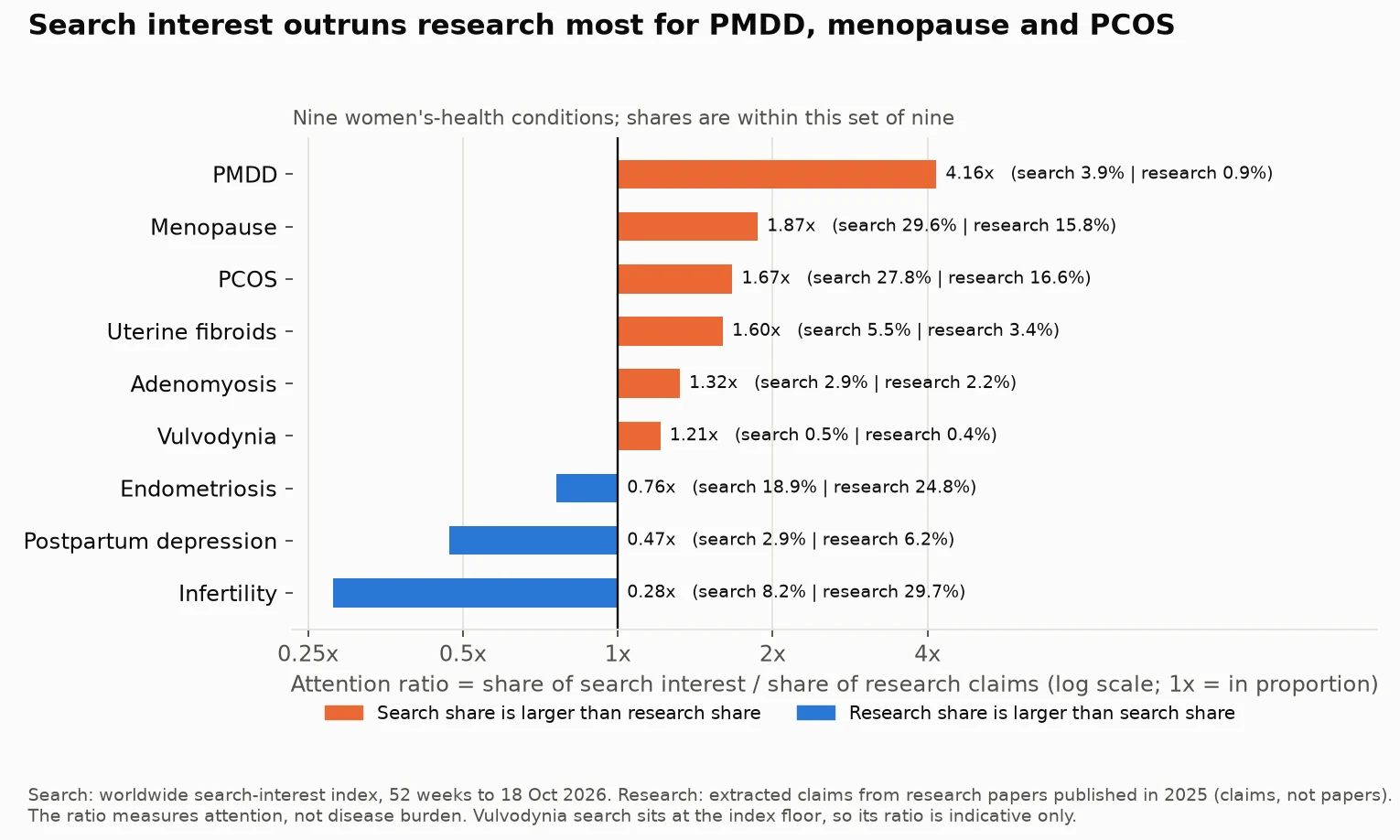
PMDD is the clearest case. It holds 3.9% of search interest but 0.9% of 2025 research claims (234 claims, against 4,190 for PCOS). Menopause holds 29.6% of search and 15.8% of claims (1.87x), PCOS 27.8% and 16.6% (1.67x), uterine fibroids 5.5% and 3.4% (1.60x). Adenomyosis (1.32x) and vulvodynia (1.21x) lean the same way, but vulvodynia's search volume sits at the lowest point of the index, so its ratio is indicative only.
The order holds when we widen the window: comparing five-year search interest with 2017 to 2025 research gives 5.0x for PMDD, 2.4x for menopause, 1.9x for both PCOS and fibroids.
Finding 2: For three conditions, research is ahead of searching
Endometriosis holds 18.9% of search interest and 24.8% of research claims (0.76x). Postpartum depression holds 2.9% and 6.2% (0.47x), and infertility 8.2% and 29.7% (0.28x). There is no search-versus-research gap here. One caution on infertility: people searching about fertility often use other words. The query "ivf" scored roughly ten times the index of "pcos symptoms" (an approximate figure, chained across requests), so a count using the single word "infertility" understates fertility interest, and the 0.28x should be read as a floor.
Finding 3: People mostly ask what it is and what the symptoms are
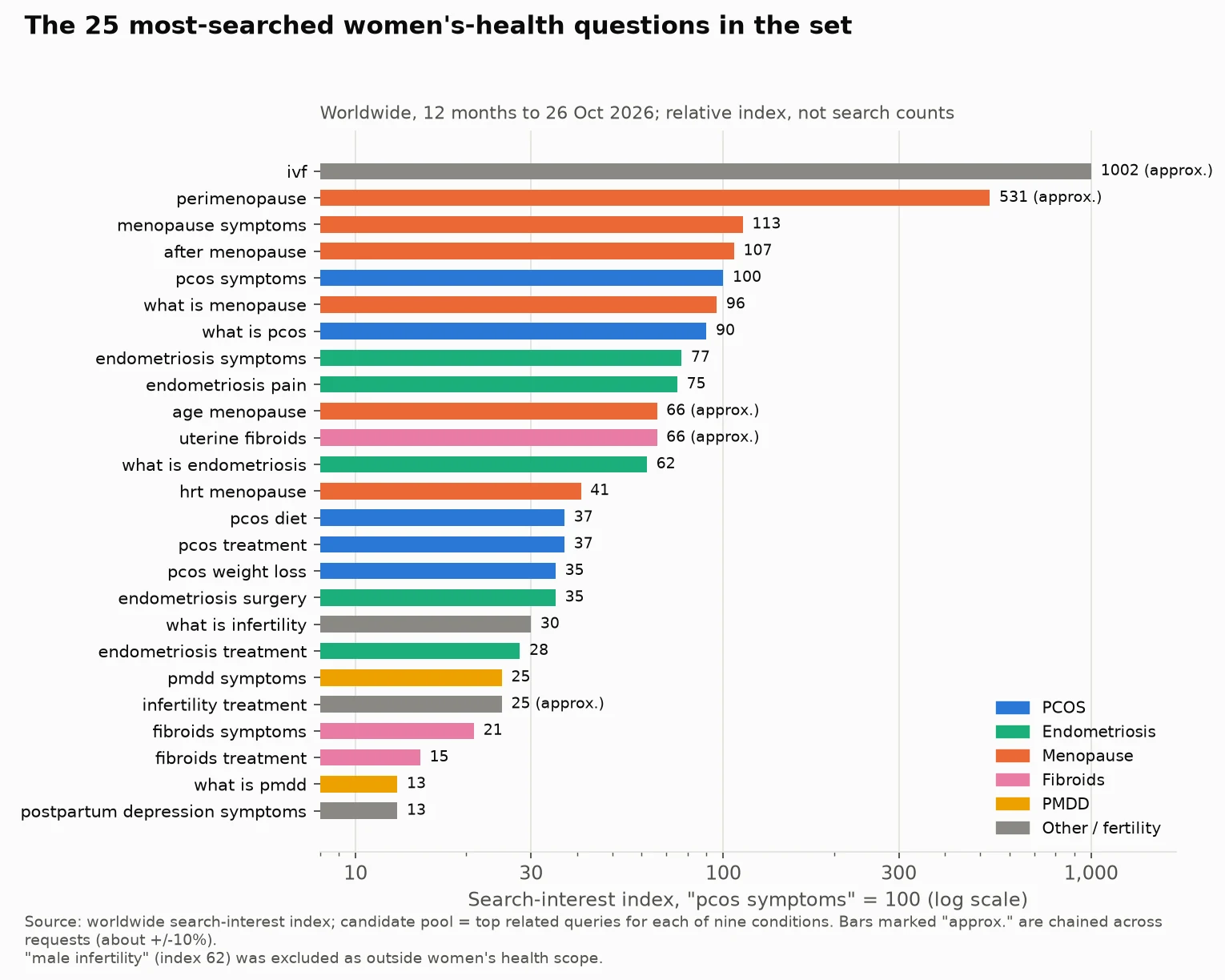
Among the 25 most-searched questions in our candidate set, 12 ask for a definition or symptoms ("what is menopause", "pcos symptoms", "endometriosis pain") and 8 concern treatment or management, such as diet, surgery or hormone therapy. "Perimenopause" stands out, scoring about five times "pcos symptoms" (approximate). The set was built from the top related searches for each of the nine conditions, so it describes these conditions, not all women's health.
Finding 4: Few research findings come from randomised trials
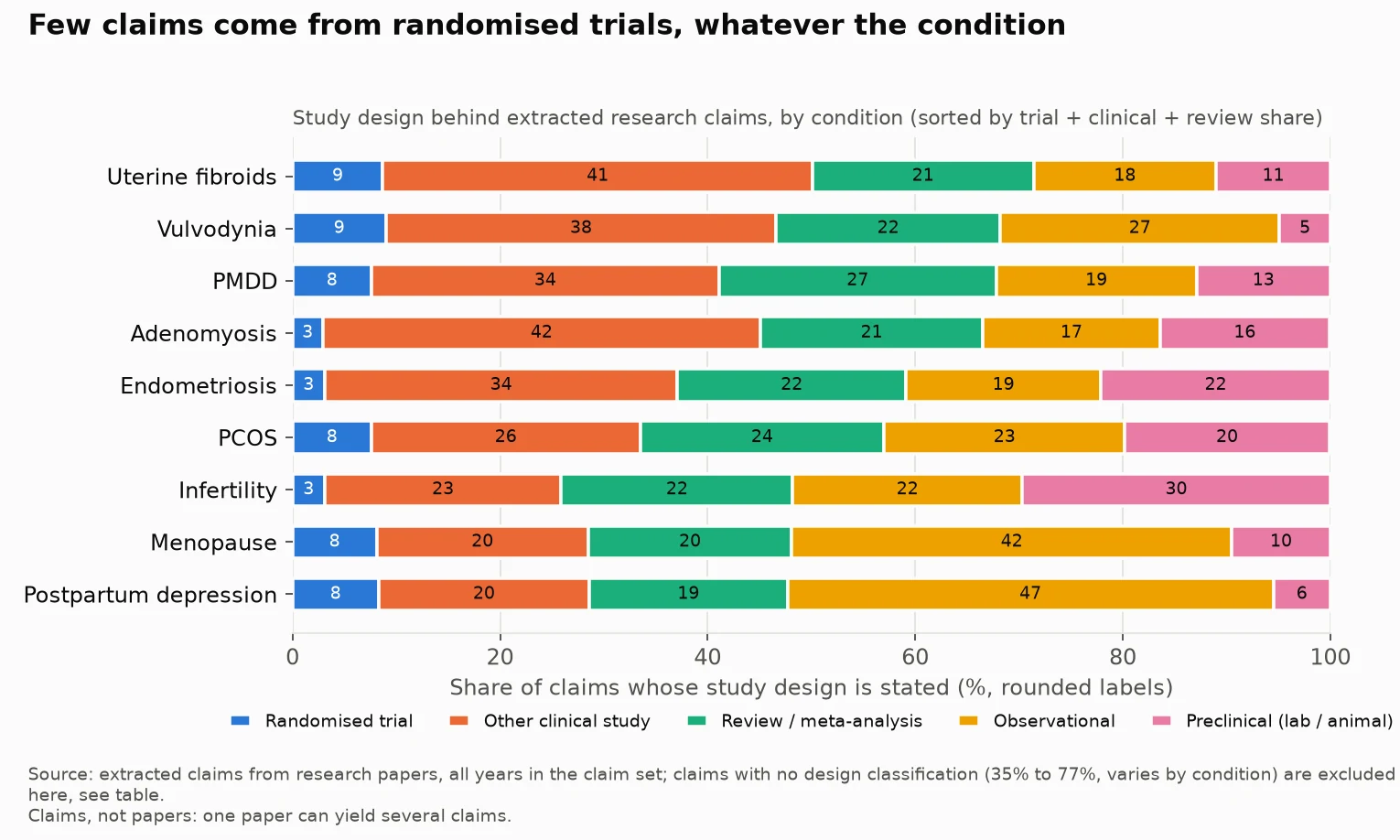
Among findings whose study design is classified, randomised trials supply between 3% (endometriosis, adenomyosis, infertility) and 9% (vulvodynia, uterine fibroids). Menopause and postpartum depression lean on observational work, at 42% and 47%. Treat the menopause mix with care: no design was classified for 77% of its claims, the highest share of the nine. In every condition, design is classified for only 23% to 65% of claims, so this is a view of the classified part, not the whole literature.
Finding 5: Interest is rising, in bursts
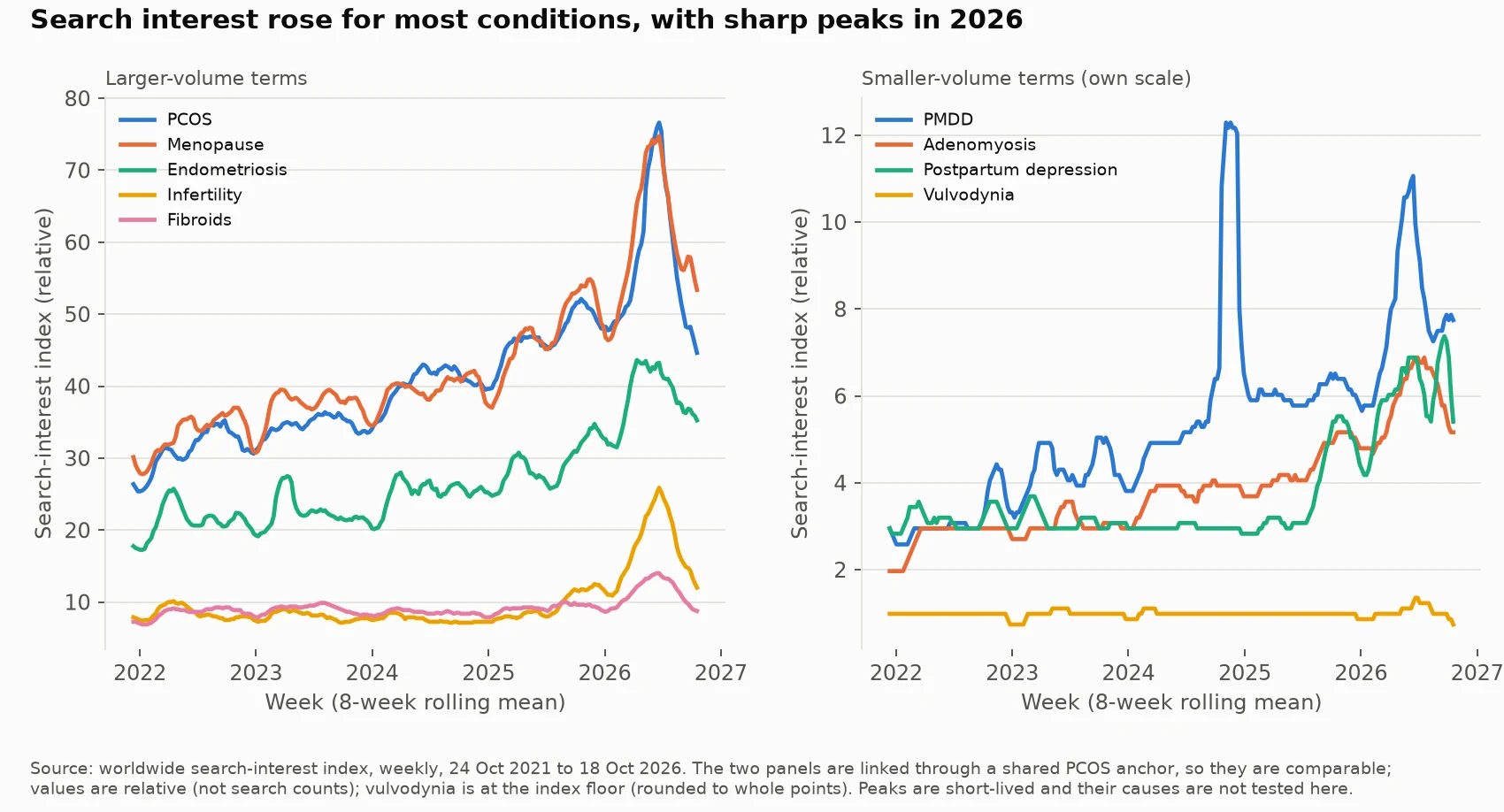
Compared with the previous 52 weeks, search interest rose by 19% (fibroids) to 84% (infertility). PCOS rose 20%, menopause 27%, endometriosis 33% and PMDD 21%; vulvodynia did not move. Part of this is two short peaks: PCOS and menopause both reached their highest 8-week average (about 77 and 75 on the index) in the same weeks of May to June 2026, and infertility peaked then too. This analysis did not test why. Research is growing as well: PMDD claims rose 92% from 2022 to 2025 and PCOS and menopause claims 77%, but from a base for PMDD about eighteen times smaller than PCOS.
Finding 6: What the news is talking about, and which themes are rising or falling
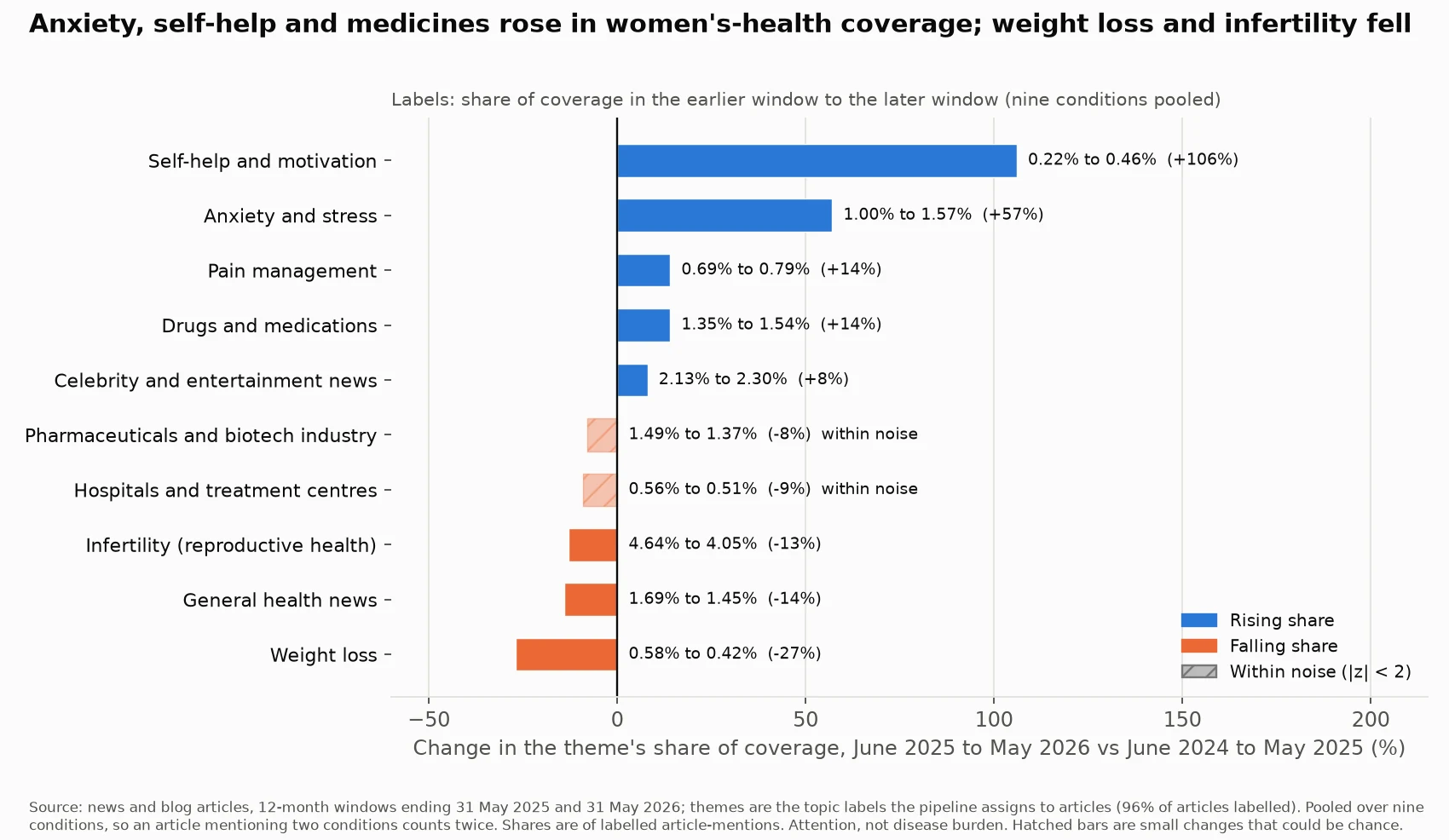
Search and research are two signals; news and blog coverage is a third, and it tells us what the conversation is about rather than how large it is. We compared the topic themes carried by coverage of the nine conditions in two equal windows: June 2024 to May 2025 (earlier) and June 2025 to May 2026 (recent). News ingest thins after May 2026, so the recent window ends on 31 May 2026 rather than today. Each article carries topic labels assigned by an automated classifier (an advertising-style topic taxonomy, with a label on 96% of articles); a "theme" here is one of those labels, and its share is the share of labelled article-mentions that carry it, pooled across the nine conditions. The pooled base was 73,873 labelled mentions in the earlier window and 77,083 in the recent one, a rise of 4%, so overall volume was steady and what moved was the mix.
Rising themes.
Self-help and motivation (articles on coping, personal routines and self-improvement) roughly doubled its share, from 0.22% to 0.46% (+106%). It is concentrated in menopause coverage, where it went from 0.5% to 1.0% of that condition's articles.
Anxiety and stress (articles on anxiety, stress and emotional strain) rose from 1.00% to 1.57% (+57%), the most statistically secure rise. It sits mostly in postpartum depression coverage, which supplies 420 of the 473 extra articles: the theme went from 8.3% to 12.4% of that condition's articles (579 to 999). A separate drill-down on postpartum depression coverage that mentions anxiety agrees: 753 articles (36.0% of that coverage) in the earlier window, 1,219 (48.8%) in the recent one.
Drugs and medications (articles about specific medicines, approvals and their use) rose from 1.35% to 1.54% (+14%). Menopause drives it: 1.4% to 2.2% of its coverage (318 to 551 articles). Coverage mentioning menopausal hormone therapy grew from 262 articles (3.7% of menopause coverage) to 479 (6.0%), and peaked in November 2025 at 126 articles, 17.3% of that month's menopause coverage. The dated events behind the peak were news reports that a US regulator would remove boxed warnings from many menopausal hormone-therapy drugs, and an approval for a hot-flash medicine; these are as reported by the articles, and we did not check them independently.
Pain management (pain relief and chronic pain) rose from 0.69% to 0.79% (+14%), and celebrity and entertainment news (public figures discussing a condition) from 2.13% to 2.30% (+8%). Both are small rises, only just beyond chance, and the celebrity theme is mixed: it rose for endometriosis and postpartum depression and fell for menopause and PMDD.
Falling themes.
Weight loss (dieting and weight management) fell from 0.58% to 0.42% (-27%). In PCOS coverage, articles that mention weight loss fell from 112 (4.9% of PCOS coverage) to 80 (3.4%).
General health news (a format label for broad news roundups, not a medical topic) fell from 1.69% to 1.45% (-14%), mostly in infertility coverage.
Infertility (reproductive health) (fertility problems and treatment) fell from 4.64% to 4.05% (-13%). The fall is in other conditions' coverage mentioning fertility, such as PCOS (3.9% to 3.4%); infertility's own coverage held at 13.3%.
Pharmaceuticals and biotech industry (the company and business angle) fell from 1.49% to 1.37% (-8%), and hospitals and treatment centres (services and facilities) from 0.56% to 0.51% (-9%). Neither is distinguishable from chance.
| Theme | Earlier window share | Recent window share | Change in share | Distinguishable from chance? |
|---|---|---|---|---|
| Self-help and motivation | 0.22% | 0.46% | +106% (+0.24 points) | Yes |
| Anxiety and stress | 1.00% | 1.57% | +57% (+0.57 points) | Yes |
| Drugs and medications | 1.35% | 1.54% | +14% (+0.19 points) | Yes |
| Pain management | 0.69% | 0.79% | +14% (+0.10 points) | Yes |
| Celebrity and entertainment news | 2.13% | 2.30% | +8% (+0.17 points) | Yes |
| Pharmaceuticals and biotech industry | 1.49% | 1.37% | -8% (-0.11 points) | No |
| Hospitals and treatment centres | 0.56% | 0.51% | -9% (-0.05 points) | No |
| Infertility (reproductive health) | 4.64% | 4.05% | -13% (-0.59 points) | Yes |
| General health news | 1.69% | 1.45% | -14% (-0.24 points) | Yes |
| Weight loss | 0.58% | 0.42% | -27% (-0.15 points) | Yes |
Earlier window: 1 June 2024 to 31 May 2025. Recent window: 1 June 2025 to 31 May 2026. Shares are of labelled article-mentions pooled across the nine conditions (73,873 earlier, 77,083 recent).
Reading it against search and research. Medicines coverage is rising where search is already ahead of research: menopause has the largest search share among the conditions with a gap (1.87x), "hrt menopause" is one of the 25 most-searched questions, and the menopause research record is the least classified of the nine (design not stated for 77% of claims), so news, search and the thinness of the record all point the same way. The anxiety theme runs the other way: postpartum depression is a condition where research is ahead of search (0.47x), so that rise is being driven by the news itself, and the dated events in the coverage were a mix of personal accounts, a public figure's interview and one research paper, not a single new finding. Weight loss is a news-versus-search gap, not a research one: coverage of weight loss in PCOS is falling while "pcos weight loss" stays among the 25 most-searched questions, so a falling news share does not mean readers stopped asking. Infertility coverage is cooling where research is already well ahead of search (0.28x), so no gap is opening there.
How much to trust this. The theme shares are small, and several changes are within noise; we show those hatched in the chart. The test treats each article-mention as independent, which flatters significance because articles repeat across outlets. Labels outside each condition's 80 highest-ranked were not returned, so small themes may be undercounted in both windows. A subcategory label for "menopause symptoms management" fell from 992 articles to 3 between the windows, which reflects a change in labelling, not in coverage, so we excluded that label scheme. The drill-down tags for postpartum depression also include items that are not about the condition (news roundup pages), so counts for that condition carry some noise. A "what is rising now" scan of the final month of data was dominated by travel and infectious-disease coverage and showed nothing on women's health, so we did not use it.
Finding 7: Where the interest sits
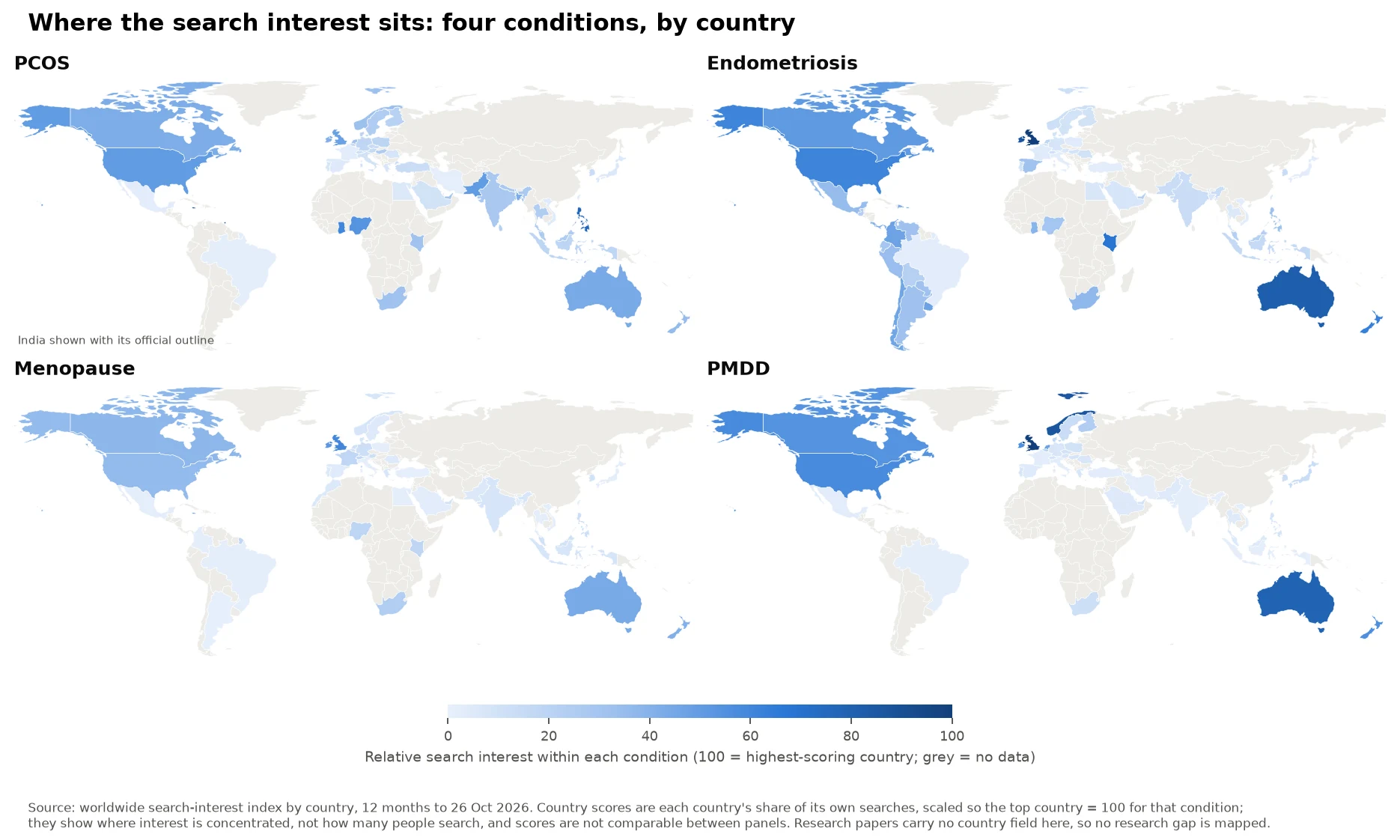
Each panel is scaled to its own highest country, so panels are not comparable. Endometriosis interest is highest in the United Kingdom, Ireland and Australia; PMDD in the United Kingdom, Norway and Australia. PCOS searches are concentrated in Trinidad and Tobago, Jamaica and the Philippines, followed by Ghana, Nigeria, the United States and Pakistan; India scores 28. Scores reflect each country's share of its own searches, which favours smaller countries. Research papers carry no country field in this analysis, so we cannot map a research gap, only where interest is concentrated.
The numbers side by side
| Condition | Search share | Research share | Ratio | News share | Trial share* |
|---|---|---|---|---|---|
| PMDD | 3.9% | 0.9% | 4.16x | 0.8% | 8% |
| Menopause | 29.6% | 15.8% | 1.87x | 32.8% | 8% |
| PCOS | 27.8% | 16.6% | 1.67x | 10.1% | 8% |
| Uterine fibroids | 5.5% | 3.4% | 1.60x | 1.8% | 9% |
| Adenomyosis | 2.9% | 2.2% | 1.32x | 1.8% | 3% |
| Vulvodynia | 0.5% | 0.4% | 1.21x | 0.3% | 9% |
| Endometriosis | 18.9% | 24.8% | 0.76x | 14.5% | 3% |
| Postpartum depression | 2.9% | 6.2% | 0.47x | 10.7% | 8% |
| Infertility | 8.2% | 29.7% | 0.28x | 27.2% | 3% |
Randomised trials as a share of claims with a classified design. News share is the share of 2023 to 2025 news and blog articles mentioning each term among the nine. Menopause draws 32.8% of news coverage against 29.6% of searches, so its coverage is in line with search while research lags; PMDD draws 0.8% of coverage.
What to take from it
For readers: the most-searched questions are basic ones, and these are the questions health-information pages answer. In the news, the conversation has moved toward anxiety, self-help and medicines and away from weight loss and fertility. For researchers and editors: PMDD, menopause and PCOS are where public questions most exceed published findings, and PMDD starts from the smallest evidence base. The World Health Organization puts endometriosis at an estimated 10% (190 million) of reproductive-age women, PCOS at 10 to 13% of women with up to 70% undiagnosed, and infertility at one in six people of reproductive age (World Health Organization, 2025a; 2026; 2025b). These are WHO estimates, not outputs of this analysis, and we found no comparable WHO figure for PMDD, so it is not placed against burden.
Method note and limitations
Data and analysis. The news, search and research-paper analysis in this article was run with Fliar Prism (Fliar Business Intelligence, 2026a), and the research tools it uses are published as the open-source Prism MCP (Fliar Business Intelligence, 2026b).
Search interest is a relative index from worldwide search-volume data, not a count of searches, with terms chained through a shared anchor and rounded to whole points. Research output is counted as claims extracted from research papers, not papers, so one paper can yield several claims, and a condition's name may capture related claims. A count of papers by subject was tested and set aside because topic matching broadened rare conditions inconsistently. News counts depend on how often a term, including acronyms, appears in articles. The theme comparison uses two 12-month windows (1 June 2024 to 31 May 2025, and 1 June 2025 to 31 May 2026), pooled across the nine conditions, with the limits described under Finding 6. Disease burden, research funding and country-level research were not measured. Shares depend on the nine conditions chosen, and a different set would change the ratios. Ratios describe proportion, not need.
References
- Fliar Business Intelligence (2026a) Fliar Prism: news, search and research-paper analysis [Data and analysis platform]. Available at: https://fliarbi.com/prism/ (Accessed: 27 October 2026).
- Fliar Business Intelligence (2026b) Prism MCP: open-source research tools [Software]. GitHub. Available at: https://github.com/fliarbi/prism-mcp (Accessed: 27 October 2026).
- World Health Organization (2025a) Endometriosis [Fact sheet]. 15 October 2025. Available at: https://www.who.int/news-room/fact-sheets/detail/endometriosis (Accessed: 27 October 2026).
- World Health Organization (2025b) Infertility [Fact sheet]. 28 November 2025. Available at: https://www.who.int/news-room/fact-sheets/detail/infertility (Accessed: 27 October 2026).
- World Health Organization (2026) Polycystic ovary syndrome [Fact sheet]. 22 January 2026. Available at: https://www.who.int/news-room/fact-sheets/detail/polycystic-ovary-syndrome (Accessed: 27 October 2026).

About the author
Fliar BI is the research team at Fliar Business Intelligence Private Limited. It studies public news coverage, scientific literature and search interest to show where attention and evidence differ.
Website: https://fliarbi.com
📖 Related Articles
Medical Disclaimer: This guest article is for educational purposes only. It compares public search interest, news coverage and the volume of published research, and it does not measure disease burden or give medical advice, diagnosis or treatment. It does not replace advice from a qualified healthcare provider. Talk with a doctor or other qualified clinician about your own symptoms or health decisions.