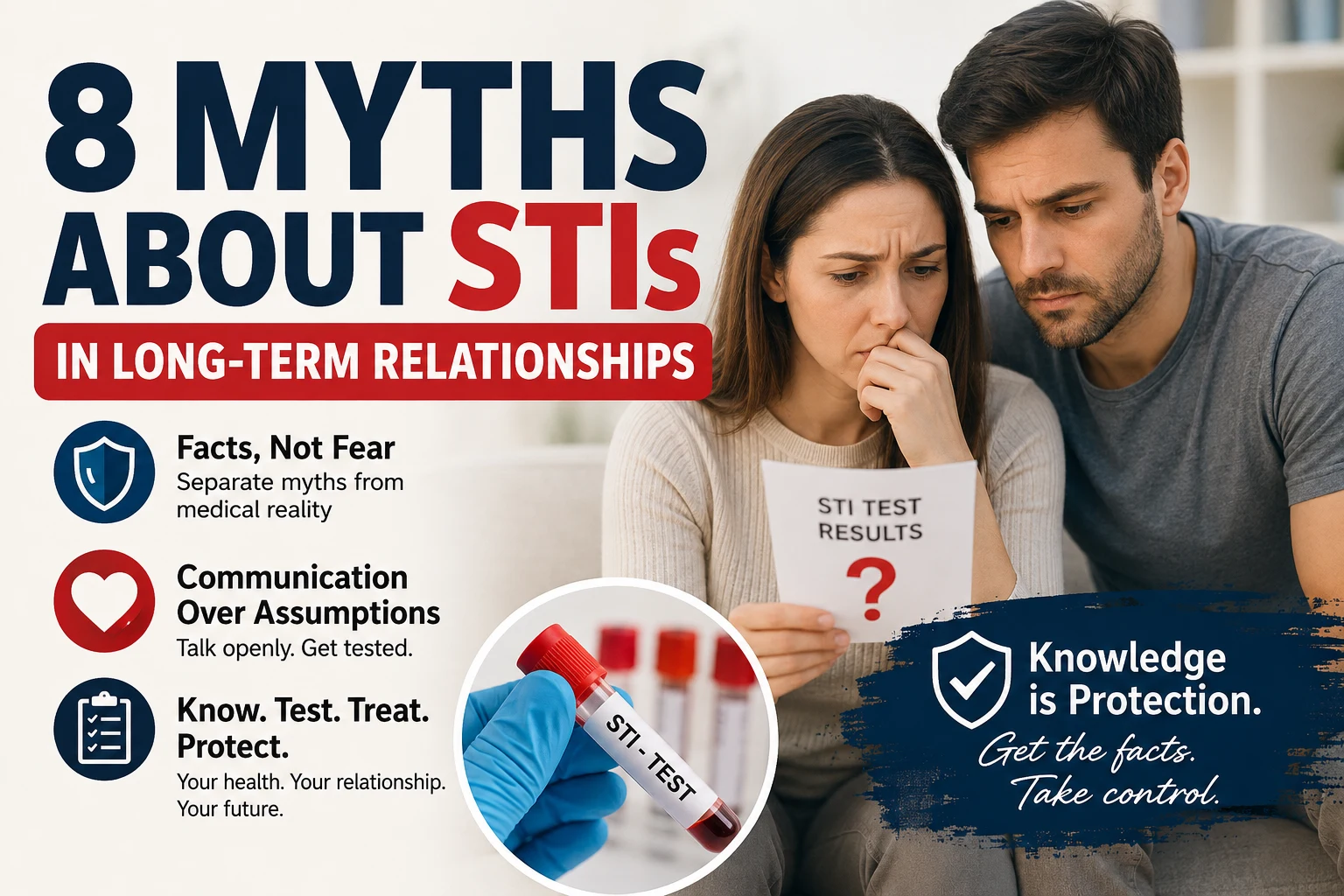
You just found out your partner has a sexually transmitted infection (STI). Your mind suddenly questions "how long has this been going on, and with who?" That immediate suspicion of infidelity is not irrational, because it definitely happens sometimes.
But other times, there's a different explanation.
Some STIs can hide in the body for weeks, months, or even years without a single symptom ever showing up. Lab tests aren't pure magic, either. They're built to detect very specific things at very specific times, which is part of why results can be confusing. And while sex is the primary route of transmission, a couple of these infections, like HIV, can also spread through shared needles or occupational exposure to blood. A positive result alone can't tell you which story you're in, and it's worth having the full picture before you draw conclusions.
Here are 8 of the most common myths about STIs in long-term relationships.
Common STIs
- Chlamydia and Gonorrhea: bacterial, curable with antibiotics, frequently asymptomatic. When symptoms do occur, they can include unusual vaginal or penile discharge, a burning sensation when urinating, or pelvic pain.
- Trichomoniasis: the most common curable STI, often asymptomatic. When symptoms do occur, they can include genitalia itchiness, skin irritation, a change in vaginal discharge, or penile discharge.
- HPV (human papillomavirus): viral, extremely common, usually clears on its own within one to two years but can persist or become detectable again later. Most infections cause no symptoms, though some types lead to genital warts or cervical cell changes.
- HSV (genital herpes): viral, manageable but not curable, can remain dormant for long stretches between outbreaks. When symptoms appear, they typically look like small blisters or sores, sometimes mistaken for skin irritation or razor bumps.
- Syphilis: bacterial, curable, with stages that can mimic other conditions. An early sign can be a single painless sore called a chancre, followed later by a rash that can appear anywhere on the body.
- HIV (human immunodeficiency virus): viral, manageable with treatment, not curable. Early symptoms can resemble the flu, but many people have no symptoms for years.
Myth #1: A Positive Test Equals Infidelity
This myth damages both relationships and people's willingness to get tested at all. Here's the clinical reality: several STIs can remain dormant or undetected for weeks, months, or years after the initial infection. HPV, for example, usually becomes undetectable within the first several months of infection. This undetectability reflects viral latency, which means the virus is dormant within a person's body, not cured. Because HPV can lie dormant without actually being cured, a lab test looking for HPV can be positive sometime later in that person's life even without a new exposure occurring. The same is true for HSV, the herpes simplex virus, which can lie dormant for long periods between outbreaks or detectable episodes.
A positive test today doesn't tell you when the infection was acquired, it just tells you it's present now. That means a new STI diagnosis inside a monogamous relationship could reflect an infection either partner acquired before you were even together. Still, this indeterminate timing doesn't completely rule out infidelity, it just means a diagnosis on its own is not proof of it. Understanding how and when the infection was acquired is a conversation for you and your partner, ideally alongside your provider, rather than something a single test result can settle by itself.
Myth #2: A Past Negative Test or Past Treatment Means You're Permanently Negative
People often believe they've achieved permanent protection from STIs if they've tested negative previously, or if they've previously been treated for a positive result. Every STI lab test has a window period, which is the time between exposure and when the infection becomes detectable via testing. Testing too soon after a possible exposure can produce a negative result even if the infection is present. A negative test from six months or a year ago only tells you about that moment in time, not about now.
Past STI treatment adds another layer of confusion. Bacterial infections like chlamydia, gonorrhea, and syphilis are curable, but a completed course of antibiotics doesn't grant immunity. In a long-term relationship, this often plays out in an unexpected way: if only one partner completes treatment, or if either partner has any other sexual contact, reinfection can occur even within an otherwise monogamous partnership. Clinicians sometimes call this a "ping-pong" effect, where an infection passes back and forth between partners because treatment happened separately instead of together.
As previously stated, viral infections like herpes, HPV, and even HIV are manageable, not curable, meaning treatment controls the virus but does not permanently resolve it. Confusing "treated" with "gone for good" leads a lot of people to assume a current symptom or diagnosis must mean something happened recently, when it may simply mean the original infection was never fully cleared or a reinfection occurred.
Myth #3: STIs Always Cause Noticeable Symptoms
Most STIs don't consistently cause symptoms. Chlamydia, gonorrhea, and trichomoniasis are frequently asymptomatic, which is a major reason the Center for Disease Control and Prevention (CDC) recommends regular routine screening as opposed to waiting for symptoms to prompt testing. HPV rarely causes any noticeable symptoms unless it leads to genital warts or cervical changes found on a pap test. Herpes outbreaks can be so mild they're mistaken for razor burn or a minor skin irritation. Some people with herpes don't have outbreaks at all.
"I feel fine" isn't the same as "I don't have anything," and this is why routine screening matters more than symptom-watching.
Myth #4: Long-Term Couples Don't Need Regular Screening
"We've been together for years" is really a response about trust in the relationship, not human biology. If either partner carried an infection like HPV or herpes before the relationship even began, it can stay dormant long enough to surface well into a long, faithful relationship, sometimes without either partner ever suspecting a thing.
The CDC recommends annual chlamydia and gonorrhea screening for sexually active women under age 25 and continued annual screening for women 25 and older who have risk factors such as a new or multiple partners, or a partner with an STI. For couples who have both been tested, treated as needed, and remain mutually monogamous, ongoing screening frequency becomes more of a shared decision with a provider than a fixed rule. The relationship's length isn't the deciding factor. Individual history and risk factors are.
This applies just as much to relationships that aren't structured around two people. People in ethically non-monogamous or polyamorous relationships often need more frequent screening simply because more partners can mean more exposure points. The same principle holds: testing frequency should track actual risk and honest communication, not assumptions based on how long you've been together or how many people are involved.
Myth #5: If It Were A Real Problem, Your Partner Would Have Told You
This idea assumes your partner is withholding information about their STI status. Oftentimes, they simply don't have it. As previously discussed, it is possible to carry an STI for years and have no idea it's there due to lack of symptoms. Many people only find out they are positive for an STI through routine screening, a partner's diagnosis prompting them to get tested, or a symptom flare that finally sends them to a provider to get checked out.
Silence isn't always concealment. Sometimes it's genuine unawareness, which is one more reason why regular screening is more important than relying on a partner to self-report something.
Myth #6: Your Regular Exam Or Pap Test Would Have Caught It
A pap test, once called a pap smear, screens for cervical cell changes related to high-risk HPV. Even though STIs like trichomoniasis can sometimes be detected on it, it is not a full STI lab test panel. Chlamydia, gonorrhea, trichomoniasis, syphilis, and HIV each require their own specific tests, and they may not be automatically included in your wellness exam visit.
If you want to know your full STI status, you must talk to your provider. Tell your provider what you'd like tested and why. More often than not, they will happily add the screening you're requesting.
Myth #7: Only People in "Risky" Relationships Need To Worry About STIs
People in stable, monogamous-presenting relationships may be convinced that they never need STI testing. Having an STI is not a reflection of relationship quality or character. STIs can be transmitted through specific types of contact and can be present in any relationship regardless of how loving, committed, or long-standing it is.
None of this erases the fact that infidelity happens, and for some people, that may turn out to be exactly what's going on. But that possibility doesn't change the clinical reality: STIs don't sort people into "safe" and "risky" categories based on relationship status. Framing STIs as something that happens only to "other people" is often what keeps people from getting tested until a symptom or a partner's diagnosis forces it. Removing the moral judgment from the conversation is often the first step toward normalizing routine screening for everyone, not just people perceived as high risk.
Myth #8: An STI Diagnosis Means The Relationship Is Over
A diagnosis is information, not a verdict. Bacterial STIs are curable. Viral STIs like herpes and HPV are manageable, often with minimal impact on daily life once a treatment plan is collaboratively developed between you/your partner and your provider. Many couples navigate the new diagnosis, work through the questions it raises together, and stay together. Others don't, and that's a decision shaped by trust, communication, and the specific circumstances involved, not by the diagnosis itself.
Panic tends to come from not knowing what a diagnosis means clinically. A conversation with a provider about what the specific infection involves, how it's treated or managed, and what it does or doesn't mean for the relationship's future can turn a frightening moment into a manageable one.
Where To Go From Here
If you're in a long-term relationship and you or your partner are facing a new STI diagnosis, everything covered above points toward the same handful of next steps:
- Talk to your provider before you convince yourself of anything that could be inaccurate. Ask about window periods, whether the specific infection can remain dormant, and what your test results can and can't tell you about timing.
- Approach your partner with curiosity before accusation. "Help me understand this" opens a conversation. "You cheated" closes one, sometimes over a conclusion that turns out to be wrong, or sometimes right. Either way, you deserve more understanding and answers first.
- Both partners should get tested and treated as needed, regardless of who was diagnosed first or what the assumed timeline is.
- Remember that a diagnosis is a health conversation, not a character judgment about you or your partner.
STI diagnoses are surrounded by stigma that human biology simply doesn't support. An STI diagnosis in a long-term relationship can mean any number of things, some harder to sit with than others, but it's rarely as simple as the first assumption that comes to mind. The goal here isn't to talk anyone out of their instincts. It's to make sure those instincts are working with accurate information instead of fear. If you have questions about your own situation, your provider is the best place to start.

✍️ About the Author
Quierra Winter Rodriguez, DNP, MSN-Ed, APRN, WHNP-BC, CNE
Women's Health Nurse Practitioner · "Dr. Q the NP"
Quierra Winter Rodriguez, DNP, MSN-Ed, APRN, WHNP-BC, CNE, known as Dr. Q the NP, is a doctorally-prepared, board-certified Women's Health Nurse Practitioner and Certified Nurse Educator with a clinical focus in STI prevention, family planning, and vaginal health. She writes evidence-based, shame-free health content through her business, Winter Written Works, LLC. Learn more at winterwrittenworks.com.
Full Profile
Medical Disclaimer: This article is for informational and educational purposes only and does not constitute medical advice, diagnosis, or treatment. Only a qualified healthcare provider can evaluate your individual situation and testing history. Always consult a doctor or nurse practitioner for personalized guidance regarding your sexual health.
Further reading from health authorities
General topic pages from authoritative organizations for further reading. They are suggested resources and are not a line-by-line citation of the statements in this article. Always confirm personal medical decisions with a healthcare professional.