
Introduction
“Kegels” is not an unfamiliar term to most women when it comes to pelvic health, childbirth, postpartum, menopause, and more. While most of us know it has something to do with strengthening, tightening, and contracting, we must also understand why building up the pelvic floor muscles is not always better.
Approximately 25–33% of women suffer from pelvic floor disorders at least once in their lifetime.
Stronger Isn’t ‘Better’: Identify When and Why
We live under a common belief that pelvic discomfort always equates to weak muscles.
Kegels are frequently advised in scenarios like:
- Bladder control, to treat urinary leakage.
- Pelvic organ support, to prevent uterine prolapse.
- An aid to post-surgical recovery for both men and women.
- Pre- and post-pregnancy, to prepare the pelvic cavity for childbirth.
Introduction to the Hypertonic or Overactive Pelvic Floor
When the core musculature of the pelvis is unable to relax, it remains in a long-standing tense or contracted phase, willingly or unwillingly.
Hence, this requires an approach that is exactly the opposite of the common belief in strengthening: lengthening, releasing, and relaxing a muscle that is already tight.
Basic Pelvic Floor Structure
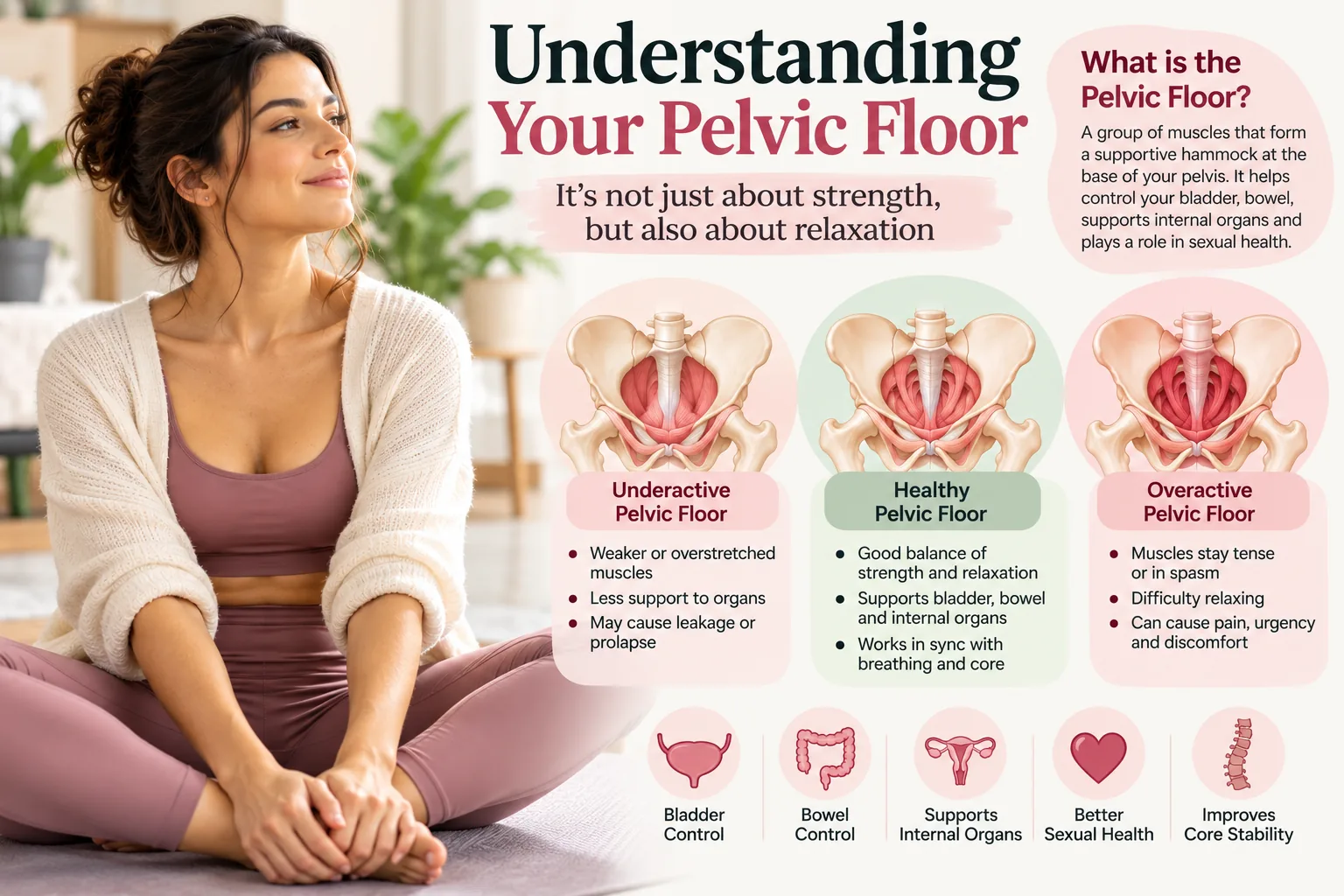
Our pelvic floor is a complex, three-layered, funnel-shaped muscular hammock. The muscles span the base of the pelvis and stretch from the pubic bone at the front to the tailbone at the back, and to the hip bones or ‘sitting bones’ on the sides.
The deeper, or strongest, layer does most of your day-to-day heavy lifting and supports the internal organs.
The middle layer, placed just underneath, covers the front triangle of the pelvis and contains the urethral valve, or sphincter, which resists or shuts off the flow of urine.
The outermost muscle layer is the superficial one, located closest to your skin, and is responsible for sexual function and the anal valve.
The pelvis is designed differently in females and males to accommodate different reproductive organs: it is wider in females, with a more flexible base, and narrower in males, to provide rigid structural stability.
Overview of Pelvic Floor Functions
- Bowel control
- Bladder control
- Sexual health
- Supporting the organs within the pelvis
- Complementing the core stability of the lower back and hip joints.
To function properly, a healthy pelvic floor needs a balance of both active contraction and active relaxation.
Key Pointers to Underactive, Normally Working, and Overactive Pelvic Musculature
- Weak/Underactive/Hypotonic Pelvis: Applies to loose, overstretched, less strong, less contractile muscles that fail to provide baseline structural support. It lacks adequate tone to support the internal organs and results in urinary/fecal leakage, bloating, or prolapse of organs.
- Normal/Healthy Pelvis: Applies to smooth and synchronized functioning of the muscles at the pelvic base, encouraging routine bladder/bowel control, support for internal organs, and healthy sexual activity. The muscles dynamically contract and relax in a cycle of contraction and lengthening.
- Overactive/Hypertonic Pelvis: Applies to a continual state of spasm or high tension within the muscles. We may experience a feeling of the muscles being ‘trapped’ or ‘stuck’, which may often lead to reduced blood flow, reduced oxygen and nutrition to the internal organs, and a constant feeling of fatigue, in contrast to the rhythmic pumping action of pushing fluids out and pulling oxygenated blood back in when the pelvis is healthy.
The reasoning behind this can be explained easily with the ‘clenched fist’ analogy.
Imagine tightening your fist, clenching your hand as hard as possible, leaving no room for further contraction. Maintaining the same position, try punching a bag or picking up a glass filled with water. You may not have enough power or correct precision left. This means the muscle is already at its maximum strength but at its shortest length, and it cannot generate enough force for a function when you actually need it.
Additionally, you may experience unsynchronized timing and broken coordination between bladder, bowel, and breathing patterns. When the bladder signals that it’s time to pass urine, the muscles must instantly drop and let it pass.
When the muscles cannot relax, the process feels like a jammed door, and you may end up straining your own muscles, along with urine retention, constipation, frequent urination, pain, and fatigue.
Indicators or Symptoms of an Overactive Pelvic Floor
As discussed above, the following signs indicate tight pelvic musculature; however, these might overlap with other medical conditions and therefore must not be assumed to be solely pelvic floor tightness.
- Urgency or difficulty in beginning urination.
- Holding urine for long hours.
- Long-standing pain around the genitals, pelvis, or rectum.
- Discomfort or sharp pain soon after sexual activity.
- Feeling strained during or after a bowel movement.
- Persistent constipation.
- Chronic stress and anxiety, such as holding the pelvic floor tight subconsciously (similar to clenching your jaw).
- Over-exercising: Unsupervised Kegels, overtraining the core, pelvic, and gluteal muscles without appropriate stretching.
- Previous history of inflammation: Pelvic surgery, endometriosis, or painful bladder syndrome.
- Posture: Prolonged sitting, habitual bracing of the abdominal muscles, or structural misalignment in the spine and hips.
The goal of a healthy pelvis isn’t necessarily a stronger pelvic floor. It is a pelvis that can contract and relax in a coordinated manner at one’s own will.
Pelvic Floor Relaxation: What Does It Essentially Mean?
The term ‘relaxation’ doesn’t simply mean ‘doing nothing’.
Gentle relaxation techniques revolve around correct guidance on:
- Breathing techniques
- ‘Down-training’
- Becoming aware of unnecessary clenching of the pelvis.
- Positioning yourself in a way that may promote relaxation.
- Light stretching wherever appropriate.
When to Seek Professional Help
All of the above factors act as red flags for situations needing medical assistance. When neglected, the issues may quickly progress into more problematic signs like blood in the urine or stool, unexplained weight loss, fever, or any numbness or sensory loss in the areas around the pelvis.
Treatment or Management of an Overactive Pelvic Floor
For treatment to be successful, a detailed evaluation by a pelvic health expert is of utmost necessity. The assessment may include a thorough examination of your muscle tone, coordination, strength, relax–contract pattern, breathing, sitting posture, and hip and pelvic mobility.
1. Pelvic Floor Physical Therapy (PFPT)
Therapists with expertise in pelvic health and wellness are the first point of contact for pelvic issues. Therapy is mostly prescribed for 10–12 weeks.
- Biofeedback therapy: This involves the use of sensors on the skin and a screen for tracking muscle activity in real time. You can visualize exactly when the muscles are contracting and relaxing. This can be very helpful for effectively training the muscles to relax and for building body–mind coordination with visual feedback.
- Trigger point/myofascial release: This involves releasing tight bands or knots, pain, and swelling in pelvic tissues with the help of gentle internal and external massage by the therapist.
- Home management tools: The therapist may teach you how to let go of the pressure in a guided manner with the safe use of a vaginal wand or a soft ball.
2. Nervous System and Breathing Regulation
Forcing tight pelvic muscles to stretch can be tough and cause a harder grip. Calming the nervous system first may allow the muscles to expand or release naturally.
- Deep breathing: Start by lying down on your back, inhale slowly through the nose, and expand your belly and lower ribcage/chest. This mechanism slowly stretches, lowers, and opens the pelvic floor. Exhale gently and completely.
- Mindfulness and body awareness: Practice scanning your body daily for any subconscious tension around your buttocks, abdomen, shoulders, or jaw. Avoid sucking in your stomach or clenching the glutes.
3. Movement Therapy
- Neuromuscular re-education: Initiating small steps to detrain what the mind holds and retrain the muscles for relaxation instead of contraction.
- Exercise techniques: ‘Reverse Kegels’ or ‘Down-training’ focus entirely on practicing a conscious drop and release of the pelvic muscles.
- Gentle stretching: Incorporating slow, pain-free movements combined with correct breathing can do wonders in opening the hip and pelvic cavity. Child’s pose, Happy Baby pose, Bird Dog pose, heel slides, marches or toe taps, and deep squats are the most essential stretching postures that may be practiced at home.
Exercises should always be prescribed by a certified therapist, as careful selection is needed to determine what may work best for you and how to do them correctly.
4. Acoustic Compression Therapy
Focused sound waves are used to target deep tissues for pain and tension relief.
5. Low-Level Cold Lasers
Low-level cold lasers are used for muscle healing at the cellular level.
6. Medications
Laxatives, vaginal/rectal suppositories, or oral muscle relaxants can help calm severe spasms and improve bladder/bowel function.
7. Interventional Therapy
Localized trigger point injections, corticosteroids, or Botox can be administered directly to treat knots and high-tone spasm.
Sacral neuromodulation may be prescribed for severe cases.
8. Lifestyle Modifications
- Adequate fluid intake.
- Reduced intake of artificial sweeteners, caffeine, etc., which are proven bladder irritants.
- Eating fiber-rich foods like berries, apples, Brussels sprouts, green leafy vegetables, and sprouts.
- Adjusting the amount of physical activity.
Can an Overactive Pelvic Floor Eventually Need Strengthening?
Yes. Once excessive tension around the pelvic muscles is adequately addressed by the practitioner, some individuals may benefit from strengthening, depending on the underlying condition.
The key to tackling the problem is to RELAX → RESTORE MOBILITY → RESTORE COORDINATION → RETRAIN → STRENGTHEN IF NEEDED. Never rely on self-prescribed treatments.
Kegels are very much worthy for the right patient, but the approach to addressing pelvic floor issues must be individualized and personalized rather than adopting a ‘one size fits all’ policy.
References
Helpful tools & related reading

✍️ About the Author
Dr. Vindhya Asthana
Physical Therapist & Ergonomist
- BPT, Apollo Hospitals
- MPT, Neurosciences
- Fellowship in Geriatric Care
- Certified Manual Therapist, Melbourne University
- Certified Dry Needling and Kinesio Taping Practitioner
- Curriculum Developer, IHFE (International Health and Wellness Education)
Physical Therapist | Clinical Content Author | Women’s Health and Wellness Facilitator
Medical Disclaimer: This article is for informational and educational purposes only and does not constitute medical advice, diagnosis, or treatment. If you have pelvic pain, urinary or bowel problems, or any of the red-flag symptoms described above, consult a qualified healthcare provider.