Contributor disclosure: This is a guest article by Gabrielle Sadkhin, Principal of Sadkhin Therapy. Her practice created Nutra77, the supplement mentioned below. The views, client example and product mentions are the contributor’s own. Bloom Health Woman does not sell, and does not independently recommend, any product or service named in this article, and links to the contributor’s website are marked as sponsored.
✨ Key Takeaways
- Appetite shifts across the menstrual cycle are well documented, and cravings often show up in the days before a period, though not everyone experiences them.
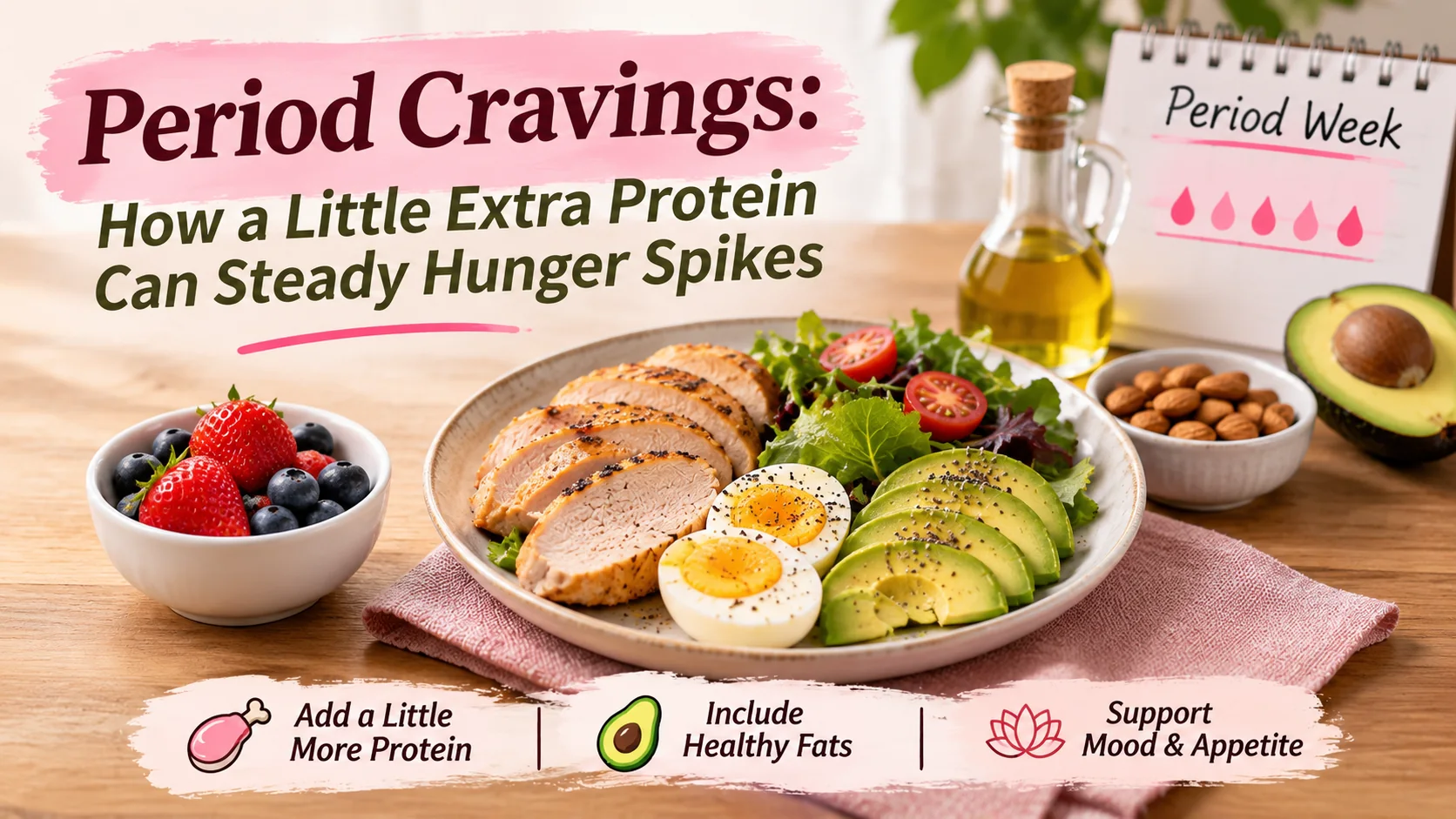
- The contributor’s first adjustment is simple: slightly increase your usual protein portion, using a protein you enjoy.
- A little healthy fat, such as avocado or olive oil, may help when sweet cravings show up.
- Keep changes small and consistent, and talk with a healthcare provider about painful periods or mood changes that disrupt daily life.
📋 In This Article
Hunger that spikes around your period can make a steady eating plan feel like it resets every month. A small adjustment at the table may take the edge off. Gabrielle Sadkhin, Principal of Sadkhin Therapy, has more than 30 years of experience helping clients with weight loss, and the adjustment she recommends starts with protein.
Why hunger changes around your period
Appetite shifts across the menstrual cycle are well documented. A research review in Human Reproduction describes energy intake dipping around ovulation and peaking in the luteal phase, the stretch between ovulation and the start of a period.[1] It also reports carbohydrate cravings in the premenstrual phase and notes that these changes may run in parallel with cyclical rhythms in serotonin, a chemical involved in mood.
Gabrielle sees this pattern in her clients, and she is quick to say it varies from person to person. Gabrielle explains, “Hormonal shifts around your period can influence appetite, although not every woman experiences hunger spikes, fatigue or mood swings.” She adds, “Stress can make cravings harder to manage, too.”
Gabrielle’s first adjustment: a little more protein
The recommendation is easy to act on. Gabrielle puts it this way:
“My advice is simple: slightly increase your usual protein portion. Turkey is a good option. It contains tryptophan, an essential amino acid your body uses to make serotonin, which helps regulate mood, sleep and appetite.”
MedlinePlus, the health information site of the National Library of Medicine, lists chicken, fish, turkey and egg whites among the foods that contain tryptophan, so the options are wide.[2] Taste matters, and Gabrielle keeps the list flexible. “If you don’t enjoy turkey, choose lamb, chicken, fish, eggs or another protein you like.”
Editor’s note: Turkey’s tryptophan content is typical of other poultry, so there is no need to force it down if you prefer something else. The tips in this article reflect the contributor’s professional experience, and large controlled studies of protein portions and premenstrual cravings are limited. Treat them as a gentle starting point, not a guaranteed fix.
A little healthy fat for sweet cravings
Sweet cravings get their own tip. Gabrielle says “a little avocado, olive oil, ghee or butter can help with the sugar cravings.” She frames the whole approach as modest: “These small adjustments may help you manage hunger and sweet cravings while staying consistent with your weight goals.”
Butter and ghee are higher in saturated fat, so if you have high cholesterol or heart disease, check with your doctor or dietitian about what suits you.
Where Nutra77 fits
Sadkhin Therapy is a natural weight loss practice with locations across New York, New Jersey and Florida. Its supplement line includes Nutra77, a green superfood powder that Gabrielle recommends alongside meals. She describes powders like it as “complementing your meals and helping fill nutritional gaps.” She also shares what clients tell her: “Many of our clients report significant reductions in cravings with regular use of Nutra77 as part of their nutrition routine.” That is client feedback, and individual responses differ.
Please note: Nutra77 is created by the contributor’s own practice. Client comments are the practice’s own reports and have not been independently verified by Bloom Health Woman. Statements about supplements have not been evaluated by the U.S. Food and Drug Administration, and supplements are not intended to diagnose, treat, cure or prevent any disease. Check with your doctor or pharmacist before starting one, especially if you are pregnant, breastfeeding or taking medication.
When cravings feel louder than usual
Appetite changes can feel more noticeable for women who are transitioning off a GLP-1 medication or looking into natural weight loss alternatives for the first time. Sadkhin Therapy offers GLP-1 support for clients at that stage, together with the food and routine adjustments described in this article.
Important: Do not start, stop or change a prescribed GLP-1 medication without advice from the clinician who prescribed it. If you are planning to come off one, ask them how to do it safely and what to expect.
A client example: Sofia
Sofia, 27, came to Sadkhin Therapy with painful periods, intense hunger spikes and added stress that made weight management harder. As part of her program, the team made one simple adjustment: an additional 100 grams of turkey and one egg, starting two days before her period and continuing through the first two days of it. She also took Nutra77 powder regularly and credited it with significantly reducing her cravings.
Over three menstrual cycles, Sofia reported that her hunger spikes eased and she felt calmer, which made her eating plan easier to follow. In just under three months she lost 35 pounds and reached her goal, and she described the experience as easy and stress free.
This was Sofia’s individual experience. Results vary.
Editor’s note: Sofia’s result came from a full program rather than a single food change, so it cannot be credited to any one element, including the extra turkey and egg. Losing 35 pounds in under three months is also faster than the gradual pace of about 1 to 2 pounds per week that the CDC describes as more likely to be kept off.[3] It is not a typical or expected outcome, and painful periods deserve a proper check-up with a healthcare provider.
Putting it into practice
- Raise your usual protein portion slightly in the days around your period, using a protein you enjoy.
- Add a little healthy fat, such as avocado, olive oil, ghee or butter, when sweet cravings show up.
- Keep the changes small so the plan stays easy to follow from one cycle to the next.
- Pay attention to stress levels, and talk with your healthcare provider about painful periods or mood changes that disrupt daily life.
🩸 Know when your period week is coming
Cravings are easier to plan for when you can see them coming. Track your cycle and spot the days before your next period.
Open Period Tracker →Hunger around your period follows patterns you can work with. A slightly larger protein portion, a little healthy fat and steady routines give many women a simple starting point, and a conversation with a qualified provider helps tailor it to your body.
Sources
- Dye L, Blundell JE. Menstrual cycle and appetite control: implications for weight regulation. Human Reproduction. 1997;12(6):1142–1151. PubMed. doi:10.1093/humrep/12.6.1142
- MedlinePlus (National Library of Medicine). Tryptophan. medlineplus.gov/ency/article/002332.htm
- Centers for Disease Control and Prevention. Losing Weight. cdc.gov/healthy-weight-growth/losing-weight
📖 Related Articles
Medical Disclaimer: This guest article is for educational purposes and does not replace advice from a qualified healthcare provider. It is not medical or nutrition advice and does not diagnose or treat any condition. Individual results vary. Talk with a doctor or registered dietitian before changing how you eat, especially if you are pregnant or breastfeeding, have diabetes, kidney disease, high cholesterol or heart disease, take prescription medication (including a GLP-1 medicine), or have ever had an eating disorder. Dietary supplements and client testimonials mentioned here reflect the contributor’s own views and have not been independently verified by Bloom Health Woman.