Introduction
The female body is nothing short of miraculous. We have the astonishing ability to create life! And as equally impressive, we can sustain that life for as long as necessary. We conceive, grow, birth, and nurture our tiny creatures until they are able to fully function on their own. And even then, motherhood does not end but carries on into the next phase of our children’s lives.
As miraculous as it is for females to accomplish motherhood, it is equally as difficult. Women experience a tremendous amount of change in a very short time span. Our minds, bodies, and spirits go through a rapid and intense transformation. All the while being responsible for this new life 24 hours a day, sleep deprived, and exhausted. Even feeling insane at times. Once our little creatures arrive, our bodies soar through a readjustment period to return us to the woman we were before conception, and truthfully, it can be one hell of an experience.
Hormones are responsible for most functions in the human body, and pregnancy is the cause of an incredibly rapid hormonal change for females. Though necessary, this ebb and flow of hormones can wreak havoc on our nervous systems, our moods, and our ability to function, and can even lead to severe mental health issues during pregnancy and after giving birth. One of the most common mental health conditions that can develop after birth is Postpartum Depression (PPD).
What Is Postpartum Depression?
Postpartum depression, or PPD, is defined as the sudden onset of major depressive symptoms beginning in pregnancy or within a four-week window of giving birth (Schiller, Meltzer-Brody, & Rubinow, 2015). PPD affects as many as 1 in 5 new mothers and can be a debilitating condition (Barney, 2022). Many women will suffer PPD in silence for a variety of reasons, including feelings of shame, guilt, fear, stigmatization, or being unaware of what is happening to their bodies. New light is now being shed on fathers who may develop symptoms of PPD, due to the sudden change-of-life, stress, and responsibility of caring for a growing family (Mayo Clinic, 2024).
Signs & Symptoms
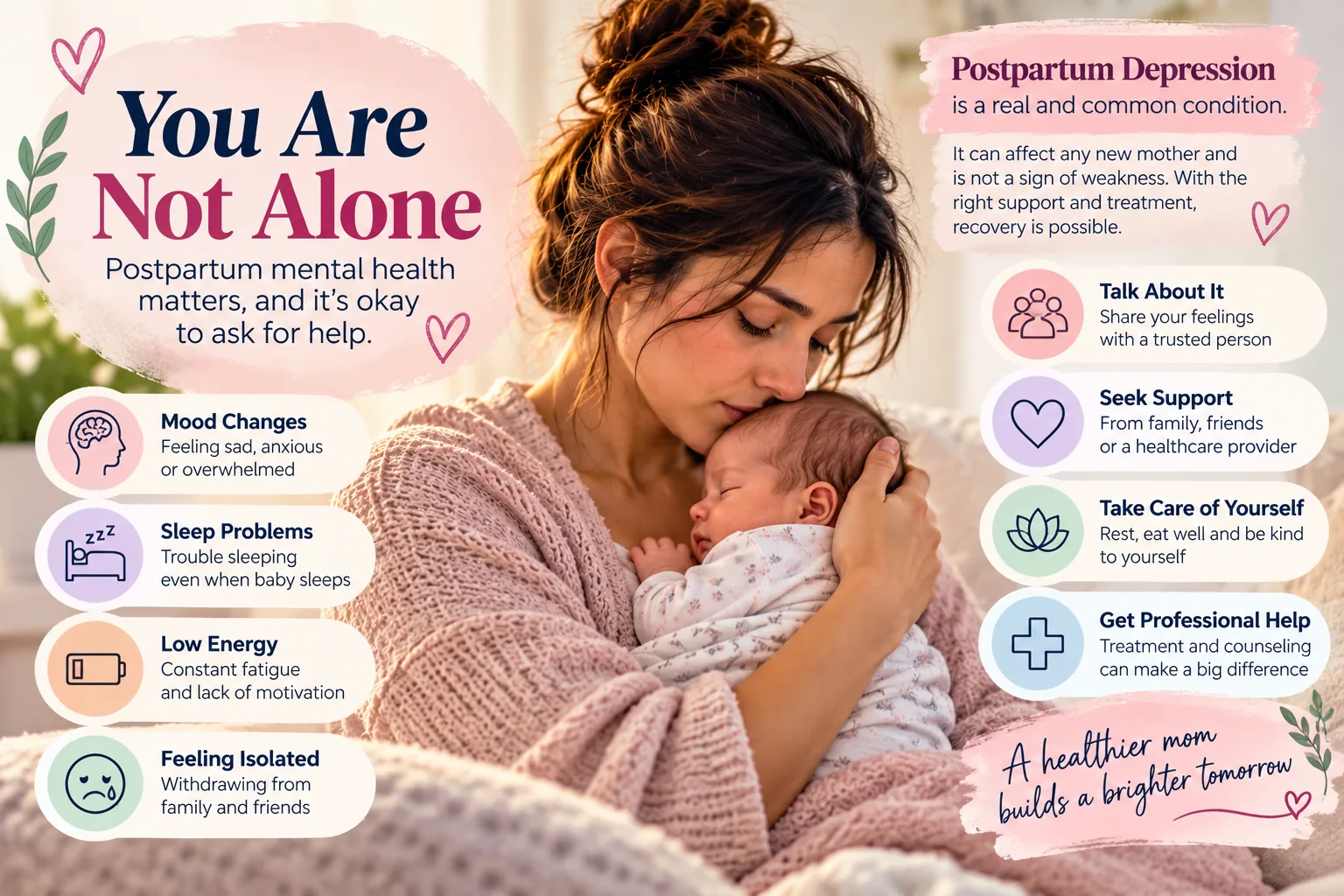
The signs and symptoms of PPD include depressed mood, appetite changes, concentration issues, fatigue and lethargy, sleep disturbances, and a decrease in self-esteem and capabilities (Schiller, Meltzer-Brody, & Rubinow, 2015). Some women may even have thoughts of harming themselves or suicidal ideations. Although PPD is characterized by specific symptoms, the illness can present differently in each individual, by number and severity of these specific symptoms (Blackhurst, 2020).
The “Baby Blues”
There is a period of time immediately after birth that many mothers may feel down, tired, scared, and/or anxious. These symptoms will usually resolve within the first two weeks and are known as the “baby blues” (Hamilton, 2018). Overall, “baby blues” symptoms are similar to those of PPD, however these symptoms last for a much shorter time frame. PPD symptoms are much more severe and can be life-altering. PPD can last for several months and through the first year (Hamilton, 2018).
The Cause
Biologically, the cause of PPD is the rapid shift in hormones that a woman’s body goes through during pregnancy and childbirth. The immediate shift of hormones can be a shock to a woman’s body, leading to very unfortunate side effects. Progesterone and estradiol are the two main hormones that lead to PPD (Schiller, Meltzer-Brody, & Rubinow, 2015). Estrogen, thyroxine, oxytocin, and pituitary-adrenal hormones also play a role in the development of PPD (Schiller, Meltzer-Brody, & Rubinow, 2015). Life stressors after having a child can add to the severity of the symptoms of PPD. Lack of sleep, newborn care, lack of paid leave, and insufficient childcare are a few stressors that are common for new mothers to face (Pearson, 2023).
Risk Factors
Risk factors for developing PPD are having a history of depression, anxiety, or other mental health disorders. Genetics, lack of social support, poor marital connection and elevated stress levels also increase the risk of developing PPD (Schiller, Meltzer-Brody, & Rubinow, 2015). Recent studies suggest that experiencing trauma in the adolescent years can sustain high levels of cortisol, which also increases the risk factor of having PPD (Pearson, 2023).
Prevention
There are many instances when PPD cannot be prevented, but there are some things that may ward off or decrease the severity of PPD. Having awareness of the illness is a good starting point. We don’t know how to prevent or treat things if we aren’t aware of them. Routine healthcare screening is important for early intervention in order to prevent progression of symptoms. Healthy lifestyle choices and parenting education are helpful as well. Having a social and family network to rely on is also key in decreasing stress during this life-changing time. Health promotion of maternal-infant bonds can help increase the bond between mom and baby and will also help elevate the mother’s mood (Mughal, et al, 2022).
Treatment
Treatment for PPD includes behavioral therapy and support groups to begin with. In many cases medications are needed. Selective serotonin reuptake inhibitors or serotonin-norepinephrine reuptake inhibitors are used to treat depression and anxiety. Recently, a new medication has been developed specifically for PPD, and it is called Zurzuvae (U.S. Food & Drug Administration, 2023). In severe cases where behavioral health therapy and medication are not effective, more intense therapies can be done. Transcranial Magnetic Stimulation (TMS) is a procedure that is non-invasive and uses magnetic waves to stimulate and activate nerve cells that are underactive in patients with depression (Mughal, et al, 2022). An additional treatment, Electroconvulsive Therapy (ECT), provides brief electrical stimulation to the brain to accomplish the same goal of nerve activation, now done under general anesthesia (Mughal, et al, 2022).
Lifelong Effects
PPD can have significant lifelong effects on the mother and her family. For the mother with PPD, there is the risk of future episodes of depression. Chronic depressive disorder could also develop if the current episode of PPD is not treated in a timely manner (Mughal, et al, 2022). Children of mothers with PPD can develop behavioral or emotional problems, delays in speech and language development, eating and sleeping issues, and Attention Deficit Hyperactivity Disorder (ADHD) (Mughal, et al, 2022).
Other mental health conditions related to PPD are postpartum anxiety (PPA) and postpartum psychosis (PPP). PPA is characterized by excessive worry, irrational fears, panic attacks, and intrusive thoughts of violent or harmful things happening to the infant (Cleveland Clinic, 2022). Postpartum psychosis is much more severe and requires immediate medical evaluation. PPP is a rare and dangerous mental illness that affects 1 in 1,000 new mothers (Cleveland Clinic, 2022). Mothers with PPP may experience delusions, a lost sense of reality, hallucinations, and even thoughts and visions of harming themselves and/or their babies (Cleveland Clinic, 2022).
The Takeaway
Experiencing symptoms of any postpartum mental health illness can be terrifying, especially when you have no idea what is happening to your mind, body, and spirit. The intention of this article is not at all to invoke fear in new mothers. The intention is for women to be educated, empowered, and unafraid to ask for help when experiencing something so life-altering as postpartum depression. You are the vessel and lifeline for the pure and divine miracle that is your child. You DESERVE love, care, and support. You are not alone.
Need support right now?
If you or someone you know has lost touch with reality, hears or sees things that are not there, or may harm themselves or the baby, call 911 or go to the nearest emergency room immediately.
References
- Barney, J. (2022). UVA Researcher Discovers What Might Cause Postpartum Depression. UVAToday. https://news.virginia.edu/content/uva-researcher-discovers-what-might-cause-postpartum-depression
- Blackhurst, Z.J. (2020). Predictors of Paternal Postpartum Depression: A Meta-Analysis. Brigham Young University, ProQuest Dissertations & Theses. https://www.proquest.com/openview/4dee52b5f9bd1fd9a8fce50f108af105/1?pq-origsite=gscholar&cbl=18750&diss=y
- Cleveland Clinic. (2022). Postpartum Anxiety. https://my.clevelandclinic.org/health/diseases/22693-postpartum-anxiety
- Cleveland Clinic. (2022). Postpartum Psychosis. https://my.clevelandclinic.org/health/diseases/24152-postpartum-psychosis
- Hamilton, J.A. (2018). Postpartum psychiatric problems. Pickle Partners Publishing. Chapter 2, 8-19.
- Mayo Clinic. (2024). Postpartum Depression. Diseases & Conditions. https://www.mayoclinic.org/diseases-conditions/postpartum-depression/symptoms-causes/syc-20376617
- Mughal, S., Azhar, Y., & Siddiqui, W. (2022). Postpartum Depression. StatPearls. Treasure Island, FL: StatPearls Publishing. https://www.ncbi.nlm.nih.gov/books/NBK519070/
- Pearson, C. (2023). Life in the Throes of Postpartum Depression. The New York Times. https://www.nytimes.com/2023/06/27/well/mind/postpartum-depression-mental-health.html
- Schiller, C.E., Meltzer-Brody, S., & Rubinow, D.R. (2015). The Role of Reproductive Hormones in Postpartum Depression. CNS Spectrums, 20(1), 48-59. doi:10.1017/S1092852914000480 https://doi.org/10.1017/S1092852914000480
- U.S. Food & Drug Administration. (2023). FDA Approves First Oral Treatment for Postpartum Depression. https://www.fda.gov/news-events/press-announcements/fda-approves-first-oral-treatment-postpartum-depression
Helpful tools & related reading

✍️ About the Author
Krystal N. Robichaux
Certified Health Education Specialist (CHES) | M.S. in Health Education and Behavior
Credentials: MS, CHES · Experience: 7 years in military healthcare
Krystal N. Robichaux, MS, CHES, is a Certified Health Education Specialist with a Master of Science in Health Education and Behavior from the University of Florida. She has seven years of experience in military healthcare, with a focus on women's health, sexual and reproductive health education, and postpartum education and support. Her work and research have focused on women's health, intimate partner safety, and postpartum mental health. She is passionate about empowering women through accessible, evidence-informed health education.
Medical Disclaimer: This article is for informational and educational purposes only and does not constitute medical advice, diagnosis, or treatment. If you are experiencing symptoms of depression or anxiety, or thoughts of harming yourself or your baby, contact a qualified healthcare provider or your local emergency services right away.